


How to Stay Valuable When AI Makes Average Work Cheap
AI is not coming for every human. It is coming for average work, and that distinction matters. Average emails, average summaries, average slides, average research, average content calendars, average first drafts, and average strategy documents are all getting easier to produce, faster to revise, and cheaper to create.
For years, average work still looked valuable because it took time. Someone had to research the topic, draft the thing, format the document, clean up the copy, and send it to the team. Effort made the work look expensive, even when the final result was only fine.
AI broke that illusion. Now the first draft can happen in seconds, the summary can appear before your coffee cools, and the rough outline can show up before the meeting even starts. That does not mean human work is dead, so please unclench. It means generic work lost its costume.
The market is no longer asking, “Did a human make this?” The market is asking, “Is this worth paying for?” That is the new game. It is uncomfortable, but it is also clarifying as hell.
The Cost of Average Intelligence Is Falling
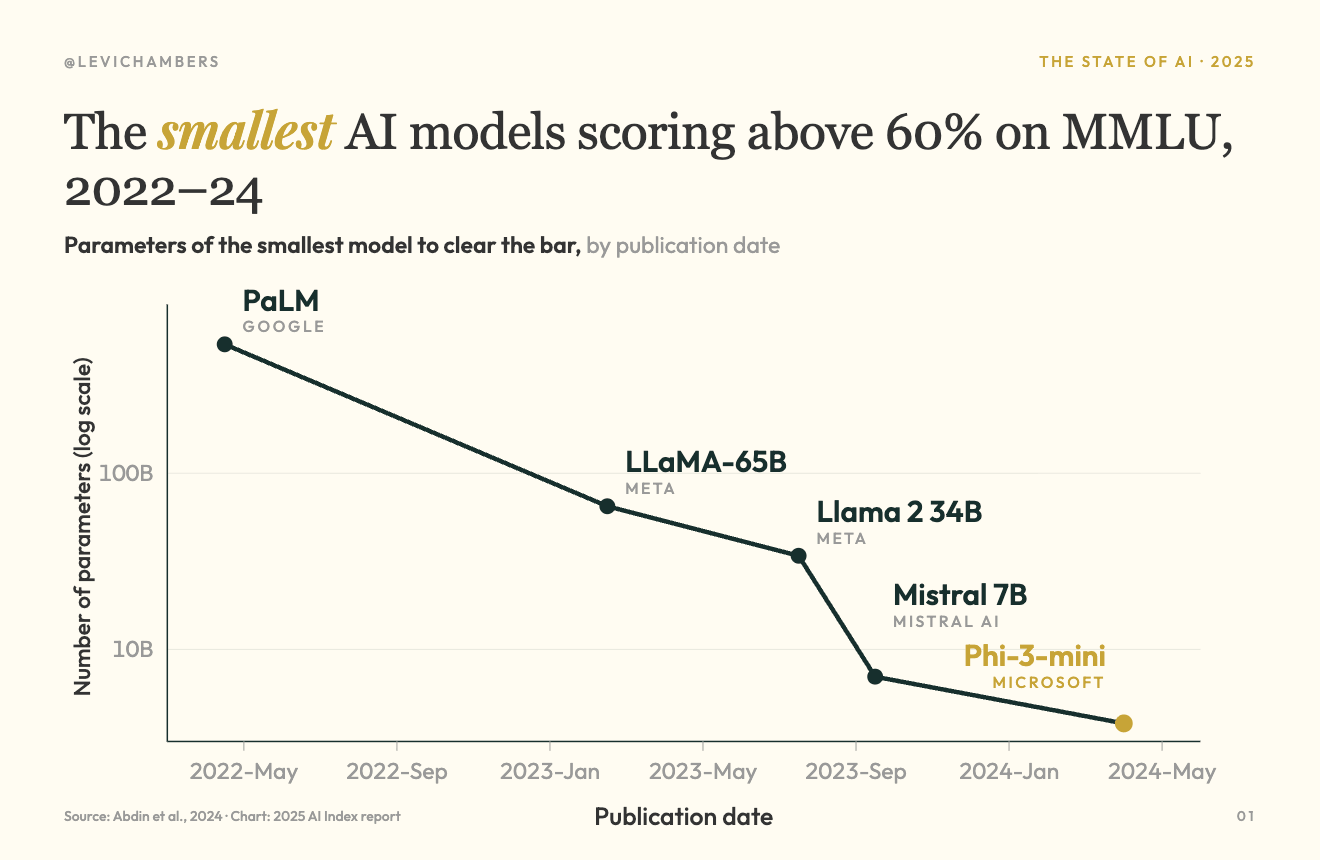
The cost of using powerful AI keeps dropping, which means more people and businesses can use it more often. Stanford’s 2025 AI Index found that the inference cost for a system performing at GPT-3.5 level dropped more than 280-fold between November 2022 and October 2024. That is not a tiny efficiency gain. That is a full reset in how cheap first-pass intelligence has become. (Stanford HAI)
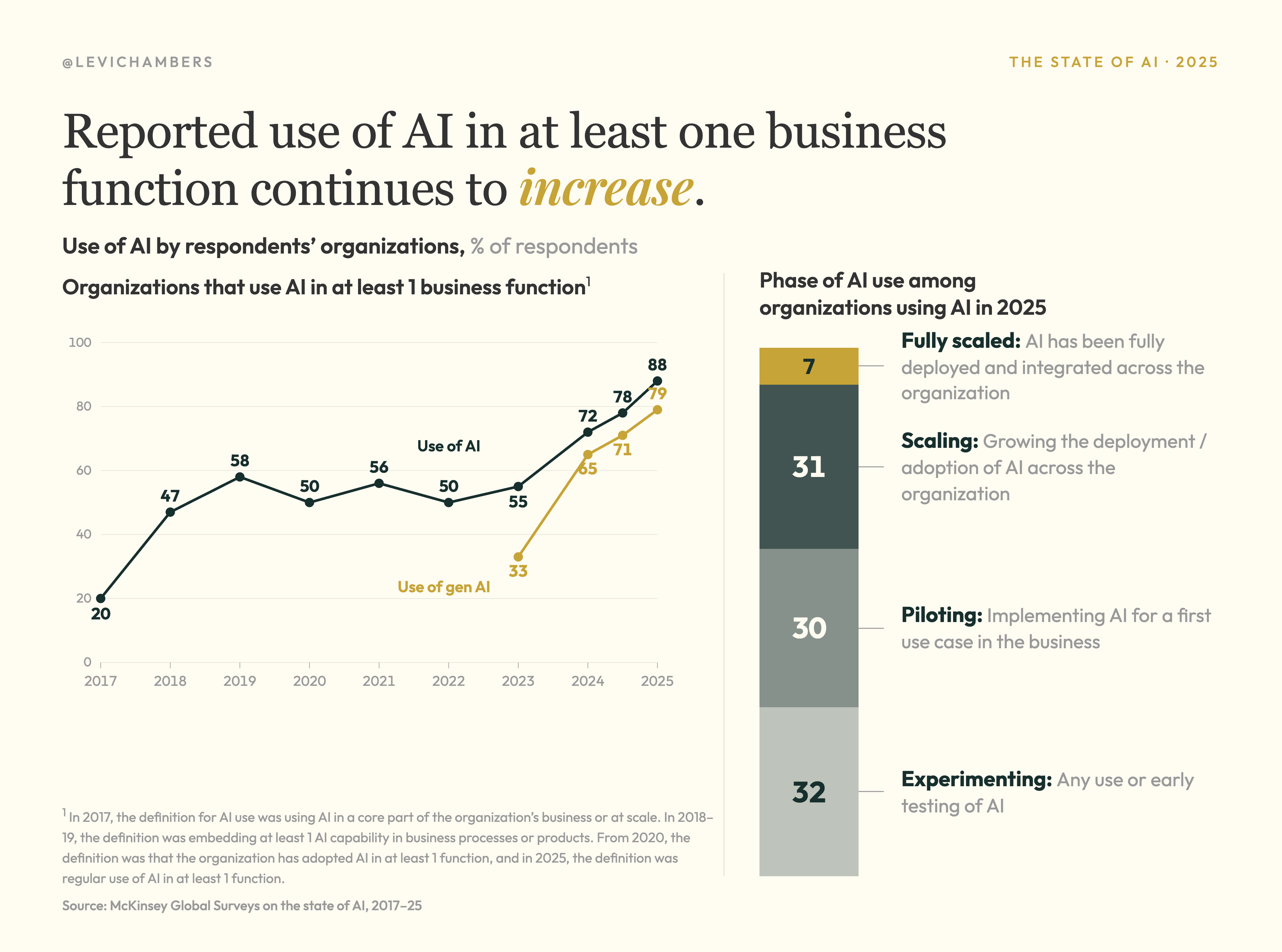
Companies are paying attention. McKinsey’s 2025 global AI survey reported that 88% of respondents said their organizations regularly use AI in at least one business function. That does not mean every company is using AI well, but it does mean this shift has moved far beyond the “early adopter” phase. (McKinsey & Company)
This is why waiting is risky. AI does not need to become perfect to change your work. It only needs to become useful enough, cheap enough, and accessible enough for people to start asking why they are paying humans for work that looks generic.
The Real Threat Is “Good Enough”
The scary part is not that AI will become better than the best people. The scary part is that AI is already good enough for a lot of average tasks. A rough memo, a basic research summary, a first-pass sales email, a simple presentation outline, or a standard operating procedure draft can now be created with almost no friction.
That matters because most workplaces are full of tasks that never needed genius. They needed time, attention, and someone willing to do them. AI changes the price of that work, and once the price changes, expectations change with it.
When the first version becomes cheap, people do not create less. They create more. More drafts, more tests, more emails, more reports, more content, more prototypes, more options, and more analysis. The bottleneck stops being “Can we make something?” and becomes “Who knows what is worth making?”
That is where your value moves. You do not stay valuable by proving you can produce the same average output faster than a machine. You stay valuable by becoming the person who knows what should exist, what should be ignored, what matters, what will fail, and what is actually worth shipping.

The New Human Edge
The future does not belong to people who avoid AI. It belongs to people who use AI to amplify the parts of themselves that are hardest to copy. Those parts are judgment, taste, context, trust, relationships, accountability, and lived experience.
AI can generate 50 options, but someone still has to choose the right one. AI can draft the email, but someone still has to know whether it sounds like the brand, speaks to the customer, and deserves to be sent. AI can summarize the report, but someone still has to know which insight changes the decision.
That someone should be you. Not because you are anti-AI, but because you are learning how to move above the output layer. The person who only makes the thing becomes easier to replace. The person who defines the problem, guides the tool, edits the result, owns the outcome, and builds the system becomes harder to ignore.
Stop Competing on Basic Output
If your main value is “I can write this,” “I can summarize this,” “I can format this,” or “I can make this look professional,” you are standing in the most crowded part of the market. AI is already very good at basic output, and it will keep getting better.
That does not mean those skills are useless. Writing, summarizing, formatting, researching, and producing still matter. The difference is that those tasks are no longer enough on their own. They need to be connected to judgment, strategy, audience understanding, and results.
The better move is to stop selling the task and start owning the reason behind the task. Do not just write the email. Understand the buyer, the objection, the timing, and the action you want them to take. Do not just make the deck. Understand the decision the deck needs to unlock.
AI can help create the output. You bring the reason the output exists.
Move From Task-Doer to Problem-Definer
The most valuable person in the room is often not the fastest producer. It is the person who pauses and asks, “What are we actually trying to solve?” That question sounds simple, but it changes everything.
Most bad work starts with a weak brief. Someone asks for a landing page when they really need clearer positioning. Someone asks for a social post when they really need a stronger offer. Someone asks for a report when they really need a decision.
AI will happily execute the wrong task if you ask it to. That is why problem-definition becomes a premium skill. The better you get at identifying the real problem, the better every AI-assisted output becomes.
Before you ask AI to create anything important, ask it to help clarify the assignment. Make it identify the audience, the goal, the constraints, the stakes, the risks, and the success criteria first. A smarter brief creates smarter work.
Sell Outcomes, Not Hours
Nobody cares that something took six hours if AI can create a usable first version in six minutes. That sounds harsh, but it is actually freeing. You do not need to prove you suffered. You need to prove you solved the right problem.
The old argument was, “This took me a long time.” The new argument is, “This saved time, reduced risk, increased clarity, improved the decision, helped the customer, or made money.” That is a stronger position.
If you are a freelancer, creator, consultant, employee, founder, or educator, this matters right now. Stop centering the labor. Center the transformation. The work is not valuable because it took effort. It is valuable because it creates a result people care about.
Your new value statement should sound less like “I spent all weekend on this” and more like “I found the problem everyone else missed.” That is how you stay expensive when production gets cheap.
Build a Context Library
Prompts are useful, but context is where the real power lives. A prompt is what you ask in the moment. Context is what AI needs to understand your voice, audience, standards, products, values, preferences, and mistakes.
If AI keeps giving you generic answers, the tool might not be the problem. The problem may be that you have not given it enough of your world. AI cannot read your mind, your customer calls, your brand standards, your sales history, or your weird little preferences unless you capture them somewhere.
Start building a simple context library. Include your bio, audience notes, brand voice, offers, product details, customer objections, examples you love, examples you hate, and rules you never want AI to break. This can live in Claude Projects, ChatGPT Projects, Notion, Google Docs, or a plain folder on your computer.
Your expertise cannot help AI if it only lives in your head. Turn your taste, standards, and scars into reusable context. That is how you stop getting average answers from average prompts.
Train Your Taste
Taste is not some mysterious gift reserved for creative geniuses in black turtlenecks. Taste is pattern recognition. It comes from reps, feedback, failure, editing, shipping, watching what lands, and noticing what people actually respond to.
AI can generate options, but taste chooses. It tells you which headline has energy, which sentence feels fake, which sales angle is too obvious, which design is trying too hard, and which idea has real heat. That skill becomes more valuable as AI creates more volume.
The way to train taste is to compare outputs. Ask AI for ten versions, then rank them. Explain why one works and another does not. Save your best before-and-after edits so your standards become clearer over time.
Your taste is not the opposite of AI. Your taste is what makes AI useful. Without it, you are just approving polished beige internet soup.
Use AI Where You Already Have Judgment
A lot of people use AI backward. They say, “I am bad at this, so AI will do it for me.” That can work for low-stakes tasks, but it gets risky fast when the output matters.
If you do not understand the work, you cannot judge the work. You might approve something that looks clean but is strategically wrong. You might publish a piece that sounds professional but says nothing. You might accept a financial model, legal summary, or business plan that misses the most important risk.
Use AI first where you already have taste. If you are a strong writer, use AI for drafts, angles, edits, and repurposing. If you know sales, use AI to test offers and objections. If you understand operations, use AI to map workflows and find friction.
Your skill is the steering wheel. AI is the engine. Do not hand the wheel to something you cannot evaluate.
Become the Editor of Abundance
The old problem was scarcity. Not enough ideas, time, drafts, research, or options. AI creates a new problem: too much of everything.
Now you can generate 30 headlines, 20 email angles, 10 business models, 15 product ideas, and a month of content in one sitting. That sounds powerful, and it is. It can also become chaos if you do not know how to choose.
Editing becomes more valuable in a world full of options. Editing is not just grammar. It is deciding what matters, what gets cut, what gets clarified, and what deserves attention. It is knowing when more is making the work worse.
The person who can manage abundance wins. Use AI to create options, then use your judgment to cut hard. The goal is not more output. The goal is better decisions.
Turn Repeat Work Into Systems
If you do the same task three times, it should probably become a system. That system can be a checklist, template, prompt, workflow, operating procedure, intake form, project folder, or review process. It does not need to be fancy. It needs to make the next round easier.
Most people use AI to finish tasks. Smart people use AI to reduce repeated friction. If clients ask the same questions, build an FAQ. If your team creates the same report every week, build a template. If every launch feels chaotic, build a launch checklist.
A task disappears after you finish it. A system keeps paying you back. That is the difference between being busy and building leverage.
This is one of the biggest upgrades you can make. Stop being the person who answers the same question forever. Become the person who builds the system that makes the question easier to answer next time.
Stay Close to Real People
AI is trained on a lot of internet content, and the internet is not reality. It is loud, messy, performative, outdated, and full of people trying to sound smarter than they are. Real customers are better.
Talk to people. Read comments, support tickets, reviews, refund requests, sales call notes, objections, and customer emails. Study what people actually say when they are confused, excited, annoyed, skeptical, or ready to buy.
The more synthetic content floods the internet, the more valuable direct human contact becomes. Real language from real people gives you an edge AI cannot invent from scratch. It shows you the problems that actually hurt, not the ones a generic persona says might matter.
Do not let AI pull you away from reality. Use AI to understand reality faster. Paste real feedback into your AI tool and ask it to find patterns, objections, emotional language, content ideas, and product opportunities based only on what real people said.
Protect Trust Like It Is the Product
Trust is the most expensive asset in an AI-powered world. Speed is useful, but speed without trust turns into noise. If AI helps you publish faster but your work gets sloppier, you lose.
This matters for creators, brands, employees, founders, and educators. Do not publish claims you cannot defend. Do not fake expertise. Do not automate touchpoints that should feel human. Do not use AI to manipulate people, invent proof, or blur lines that should stay clear.
AI can help you move faster, but you are still responsible for what you send into the world. Your audience does not need you to be anti-AI. They need you to be accountable.
Before publishing important work, ask AI to check for trust risk. Have it flag unsupported claims, vague promises, privacy issues, tone problems, ethical concerns, and anything that could damage credibility. Then make the human call.
Kill Unnecessary Work Before You Automate It
AI makes it easy to add more. More emails, more reports, more dashboards, more automations, more posts, more workflows, more meetings disguised as productivity. More is not always better.
Sometimes the smartest move is to remove. Remove the report nobody reads. Remove the meeting nobody needs. Remove the workflow step that only exists because someone created it in 2018 and everyone got too tired to question it.
Do not use AI to make bad systems faster. That is just chaos with better formatting. Use AI to ask what should stop existing before you ask what should be automated.
This is where taste becomes operational. Taste is not only knowing what to create. Taste is knowing what to kill before it wastes another hour of everyone’s life.
Build Public Proof of Your Thinking
If average output gets cheap, your thinking needs to become visible. This matters whether you are a creator, employee, freelancer, founder, consultant, or educator. People need to see how you make decisions, not just what you produce.
Share your frameworks. Explain your process. Break down mistakes. Show before-and-after examples. Teach what you noticed. Tell people why one option worked and another failed. That kind of proof makes you harder to compare to a tool.
AI can generate a post, but it cannot be you. It does not have your lived experience, your relationships, your community, your scars, your taste, or your receipts. Your edge is not simply what you know. It is how you see.
This is why publishing matters. Public thinking builds trust before the sale, the interview, the pitch, or the opportunity. It tells people there is a human behind the work with judgment they can actually follow.
Make AI a Practice, Not a Panic Button
Most people use AI only when they are behind. They are rushed, overwhelmed, and desperate for a shortcut. Then they ask a weak question, get a weak answer, and decide the tool is overhyped.
That is not AI strategy. That is panic prompting.
AI gets powerful when it becomes a weekly practice. Pick one workflow each week and improve it. Build one better prompt, update one context file, review one output, create one system, or ask AI to find one bottleneck you can remove.
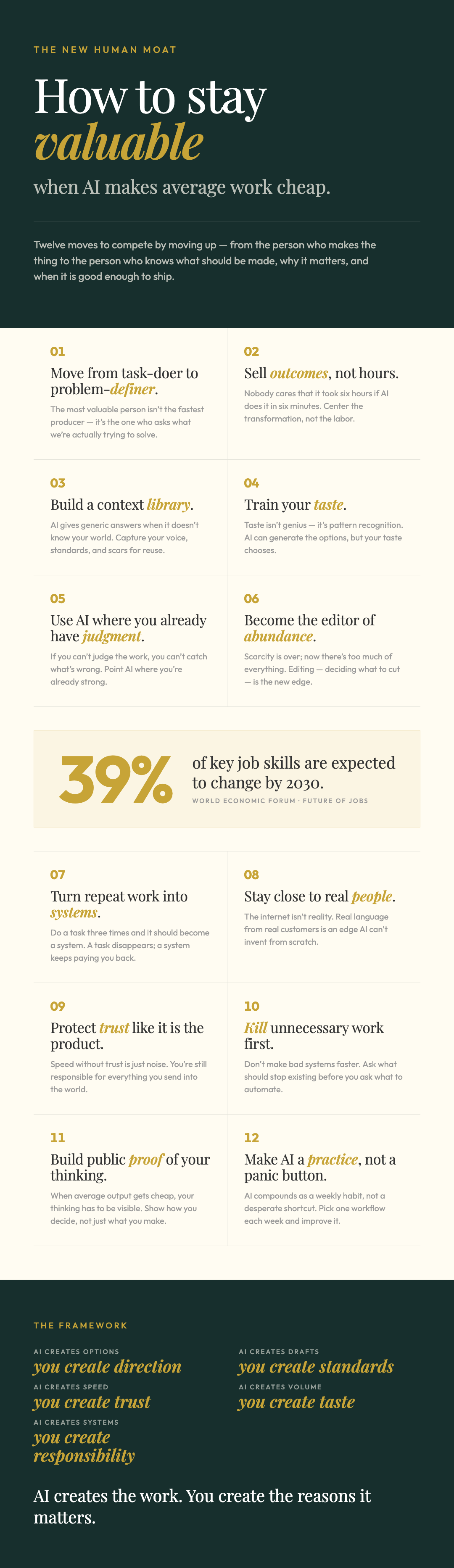
The World Economic Forum’s Future of Jobs research says employers expect 39% of key skills required in the job market to change by 2030. That is not a reason to panic, but it is a reason to practice. Your AI skill will not compound if you only touch these tools when you are already stressed. (World Economic Forum)
You do not need to become an AI expert overnight. You need to stop treating AI like a random tool you use sometimes and start treating it like a real skill you build on purpose.
The New Human Moat
People love saying “AI will never replace humans” because it feels comforting. Comfort is not a strategy. AI will replace some tasks, pressure some roles, and expose work that was only valuable because it used to take time.
But AI will also make sharp people sharper. It will help creators create more, entrepreneurs test faster, teachers explain better, employees automate busywork, and small teams build things that used to require bigger budgets.
The human moat is not simply “being human.” That is too vague to be useful. The human moat is context, judgment, taste, trust, relationships, responsibility, lived experience, and the ability to turn messy reality into useful decisions.
That is the work now. Not fighting AI on what it does best, but moving toward the value it cannot create alone.
The Academy of AI Framework
Here is the framework I want you to remember. AI creates options, but you create direction. AI creates drafts, but you create standards. AI creates speed, but you create trust. AI creates volume, but you create taste. AI creates systems, but you create responsibility.
That is how you compete. Not by pretending AI is not powerful. Not by trying to outwork a machine. Not by hiding from the future and hoping your industry gets a hall pass.
You compete by moving up. You stop being only the person who makes the thing. You become the person who knows what thing should be made, why it matters, who it serves, how it should work, and when it is good enough to ship.
That is a very different job. It is also a much better one.
Your First Assignment
Open Claude, ChatGPT, Gemini, or whatever AI tool you use and paste this prompt. Do not just read it and nod like a responsible adult. Run the audit and look at the answer honestly.
Help me identify the parts of my work that are most vulnerable to AI.

My role is: [insert role]
My main tasks are: [insert tasks]
My strongest skills are: [insert skills]
My audience, customers, or stakeholders are: [insert people]
My goals are: [insert goals]

Sort my tasks into 4 categories:

1. Work AI can probably do faster
2. Work AI can help me do better
3. Work that still needs my judgment
4. Work I should turn into a reusable system

Then give me a 30-day plan to become more valuable by using AI instead of competing against it.
This is where the shift starts. Find the weak spots, build the systems, capture your context, train your taste, stay close to real people, sell outcomes, protect trust, and practice every week. Average work is getting cheaper, but you do not have to stay average.
Subscribe to Academy of AI
Academy of AI helps everyday people learn the tools already changing work, money, creativity, and freedom. No panic, no jargon, and no gatekeeping. Just practical AI education for people who want to stay sharp, build smarter, and move with the future instead of getting dragged by it.
Subscribe to Academy of AI if you want to use AI with more clarity, confidence, and power. Bring your ambition, your questions, and your beautiful, messy, human brain. We have work to do.