


ChatGPT won’t make you dumb, but bad AI habits will.
I use ChatGPT every day. I use it to write, plan, brainstorm, organize ideas, build systems, test angles, clean up messy thoughts, and move faster when my brain has too many tabs open. I love it. I also think a lot of people are using it in a way that quietly makes them weaker.
Not because ChatGPT is evil. Not because AI is rotting everyone’s brain. Not because we all need to throw our laptops into a lake and start journaling by candlelight like dramatic little Victorian ghosts.
The problem is simpler than that. A lot of people are letting ChatGPT think before they do.
That is where things get messy. When you open ChatGPT before you have even tried to form your own thought, the tool does not just help you. It starts steering. It gives you the structure, the language, the argument, the examples, and the ending before your brain has done any real work.
Then you edit what it gave you and call it collaboration.
Sometimes that is fine. Sometimes you just need a quick email or a cleaner grocery list. But if you do that for important work over and over again, you start skipping the part where your own thinking gets stronger.
That is the real risk.
Not AI.
Skipping the reps.

The Problem Is Not ChatGPT. The Problem Is Autopilot.
Let’s use a gym example because it makes this painfully obvious. Imagine you hire a trainer, but every time you show up, the trainer lifts the weights for you. You still go to the gym. You still watch the workout. You still feel involved. But your body is not doing the hard part.
That is how a lot of people use ChatGPT.
They ask it to write the draft before they know what they think. They ask it to summarize the book before they try to understand the chapter. They ask it to build the strategy before they define the problem. They ask it to explain the meeting before they sit with what actually happened.
The output appears, so it feels productive. But your brain did not have to push.
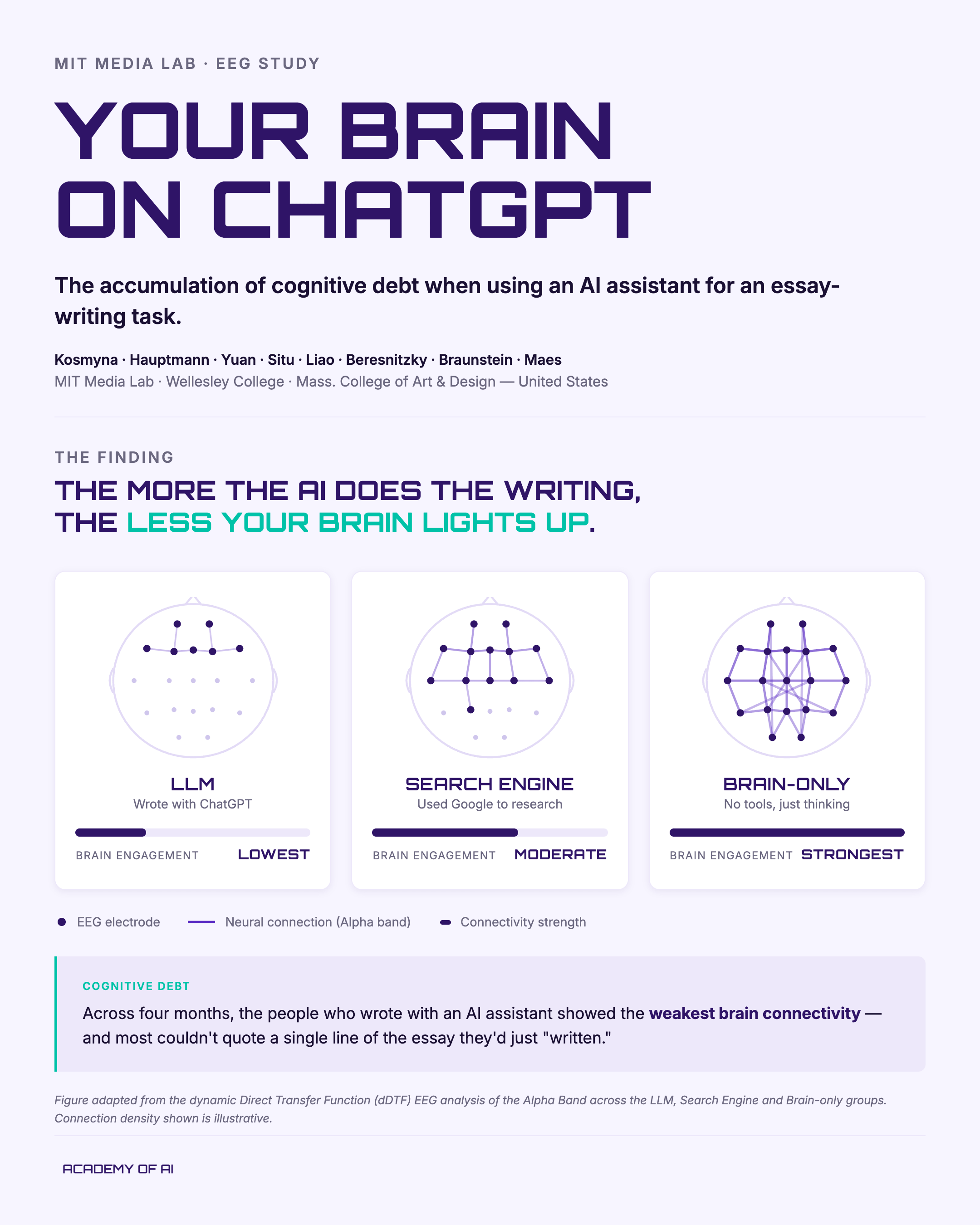
That is what people mean when they talk about “cognitive debt.” You get the answer now, but you may not really own it later. You have the paragraph, but not the memory. You have the plan, but not the judgment. You have the polished version, but not the thinking underneath it.
That is not leverage. That is borrowing.
And eventually, the bill shows up.
The Study Everyone Is Talking About
A 2025 preprint called Your Brain on ChatGPT looked at how people wrote essays with different kinds of support. The researchers had 54 participants write SAT-style essays across three groups: one used an AI assistant, one used search engines, and one wrote without tools. The study used EEG to look at brain connectivity during writing, and it found that the brain-only group showed the strongest brain-network engagement, the search group landed in the middle, and the AI group showed the weakest connectivity. The AI group also reported the lowest sense of ownership over their essays and had more trouble quoting their own work afterward. (arXiv)
That is a big deal, but I want to be careful here. This does not prove that ChatGPT makes everyone dumb. It was one study, with one kind of task, in a controlled setting. Essay writing in a study is not the same thing as running a business, building a course, editing a newsletter, coding a product, or planning your week.
But the warning is useful. If you let AI do the thinking first, your brain may stay less engaged. That should not scare us away from AI. It should teach us to use it better.
The order matters.
Think first. Then use AI.
That one change can completely shift the relationship.
AI Can Also Make You Better
Here is where the conversation gets more interesting. AI is not only a risk. Used well, it can make people faster and better.
In a field experiment with 758 consultants at Boston Consulting Group, researchers found that GPT-4 helped consultants complete more tasks, work faster, and produce higher-quality results on tasks that fit within the model’s strengths. But the same research also found that when consultants used AI for a task outside the model’s strengths, they performed worse than people who did not use AI. BCG described this as the “jagged frontier,” meaning AI is great at some things and unreliable at others. (SSRN)
That is the whole lesson. AI can make you better when you know where it helps. AI can make you worse when you trust it in places where you cannot judge the answer.
Developers have seen the upside too. A controlled study on GitHub Copilot found that developers with access to the AI pair programmer completed a coding task 55.8% faster than the control group. (arXiv) Creative work has the same tension. Research on AI-assisted story writing found that AI ideas could improve ratings for creativity and enjoyment, especially for less experienced writers, but AI-assisted stories also became more similar to each other. (arXiv)
So no, the takeaway is not “AI bad.”
The takeaway is this: AI can make strong thinkers stronger, and it can help weak thinking look polished before it is ready.
That is the line we need to watch.
My Rule: Do the First Messy Version Yourself
This is the rule I want you to steal.
Do the first messy version yourself.
Before you ask ChatGPT to write the article, write the ugly outline. Before you ask it to build the strategy, write what you think the problem is. Before you ask it to summarize a topic, explain what you already understand. Before you ask it to create the sales page, write the rough offer in your own words.
It does not need to be good. Actually, it probably should not be good. The first version is allowed to be awkward, uneven, dramatic, unfinished, and full of half-formed thoughts. That is the point.
That messy first version proves your brain showed up.
Once you have your own thinking on the page, ChatGPT becomes way more useful. Now it has something to respond to. It can help you find what is unclear, what is missing, what is repetitive, what is strong, what needs evidence, and what should be cut.
That is very different from asking it to create the whole thing from zero.
One makes AI your assistant.
The other makes AI the driver.
I want you driving.
Start With Ten Minutes of Your Own Thinking
Before opening ChatGPT, give yourself ten minutes. Set a timer. Write what you think. Do not edit. Do not make it cute. Do not worry about grammar, structure, or whether the idea is “good enough” yet.
Just get your thoughts out of your head.
This works for almost anything. An article. A pitch. A hard email. A business idea. A lesson plan. A launch. A personal decision. A product outline. A meeting recap.
Once the timer ends, then bring in ChatGPT and say:
I wrote this rough version before asking for help.

Please read it and tell me:
1. What my main point seems to be
2. What feels strongest
3. What feels unclear
4. What I am repeating
5. What questions I need to answer before improving it

Do not rewrite it yet.
Here is my draft:
[paste draft]
That last line matters. “Do not rewrite it yet.”
You are not ready for polish. You need clarity first.
Ask ChatGPT to Push Back
Most people use ChatGPT like a very agreeable assistant. That can be helpful, but sometimes it is too soft. If your idea is weak, you do not need a cheerleader. You need someone to tell you where it breaks.
This is one of the best ways to use AI. Make it challenge you before the real world does.
Paste your idea and ask:
I want you to challenge this idea before I spend more time on it.

Tell me:
1. What feels unclear
2. What assumptions I might be making
3. What a skeptical reader, buyer, or client would question
4. Where this could fail
5. What would make it stronger

Be direct, but useful.
Here is the idea:
[paste idea]
This is not about letting ChatGPT destroy your confidence. It is about making your idea stronger while it is still cheap to change.
That is the gift. It is much better to find the weak spot in a chat than after you publish, launch, pitch, or spend three weeks building the wrong thing.
Use ChatGPT to Find What You Missed
This is where AI gets really helpful. After you have your own draft or plan, ask ChatGPT to find the holes.
Not to take over. Not to rewrite everything. Just to help you see what you missed.
Maybe your article needs a better example. Maybe your sales page avoids the biggest buyer objection. Maybe your plan has a timing problem. Maybe your argument has a gap you did not notice because you were too close to it.
Use this prompt:
Review this and help me find what is missing.

Look for:
1. Missing examples
2. Weak logic
3. Unanswered objections
4. Repetition
5. Claims that need proof
6. Places where the reader might get confused
7. Sections that should be cut or simplified

Do not rewrite the full piece. Give me a clear improvement list.
Here is the draft:
[paste draft]
This is how you use AI without disappearing into it. You keep ownership. ChatGPT helps you see the blind spots.
That is a healthy relationship with the tool.
Make Sure You Can Explain the Work Without Looking
This is the part most people skip.
After ChatGPT helps you create something, close the chat and explain the final idea out loud. Seriously. Say it like you are explaining it to a friend.
What is the main point? Why does it matter? What are the strongest examples? What is the conclusion? What would someone disagree with? What are you asking the reader, client, customer, or team to do next?
If you cannot explain it without looking, you do not fully own it yet.
That does not mean you did something wrong. It means you need one more pass.
Use ChatGPT to quiz you:
Quiz me on this work so I can make sure I actually understand it.

Ask me 7 short-answer questions about:
1. The main idea
2. The strongest argument
3. The weakest point
4. The key examples
5. The assumptions
6. The conclusion
7. The next action

Do not show me the answers until I respond.
Here is the work:
[paste final draft or summary]
This is especially useful if you are a student, creator, founder, teacher, or anyone using AI to publish or present ideas. If your name is on it, your brain should be in it.
Check the Logic Before You Trust the Answer
ChatGPT can sound confident when it is wrong. We know this. We have all seen it make something up with the energy of a man in a linen shirt explaining crypto at a pool party.
So when the answer matters, ask it to show you the assumptions.
You do not need a giant behind-the-scenes reasoning diary. You need the clean version: what is it assuming, what is uncertain, what needs checking, and where the answer might fail.
Use this:
Before I rely on this, help me inspect the logic.

Break it down into:
1. Main recommendation
2. Key assumptions
3. What information is missing
4. What could be wrong
5. What I should verify
6. A safer version of the recommendation

Here is the answer:
[paste answer]
Use this for anything involving money, health, legal issues, business strategy, research, data, travel, taxes, or public claims. Basically, anything where being wrong would be more than mildly annoying.
ChatGPT is great. Verification is still your job.
Make the Final Version Sound Like You
One of the biggest problems with AI writing is not that it is bad. It is that it can be aggressively fine.
Clean. Polished. Smooth. Empty. Like a hotel lobby with Wi-Fi.
That is not what we want.
If you are using ChatGPT to write, your final pass needs to bring you back into the work. Your voice. Your rhythm. Your taste. Your humor. Your opinions. Your lived experience. Your little human fingerprints.
The draft can get help. The final version needs you.
Use this prompt:
Review this draft and flag anything that does not sound like me.

Look for:
1. Generic AI phrasing
2. Corporate language
3. Sentences that are too polished
4. Predictable transitions
5. Places where my opinion should be stronger
6. Moments that need a more human example

Do not rewrite everything. Show me what to fix and suggest better options.
Here is the draft:
[paste draft]
Then read it out loud. If you would never say it to a friend, do not publish it.
That is the simplest voice test.
Use AI Where You Have Taste
Here is another rule I love.
Use AI first in areas where you already have taste.
If you know writing, use ChatGPT to help with drafts, hooks, edits, and repurposing. You will know what sounds good and what sounds fake. If you know sales, use it to test offers, objections, and email angles. You will know what feels persuasive and what feels desperate. If you know operations, use it to map workflows. You will spot missing steps fast.
But if you know nothing about the topic, slow down.
AI can still help you learn, but do not treat the first answer like the final answer. Ask for sources. Ask what beginners misunderstand. Ask what experts would disagree with. Ask what you need to verify before acting.
Use this prompt when you are new to something:
I am new to this topic, so do not assume I can judge your answer well.

Explain it simply. Tell me what beginners usually misunderstand. Flag anything that may be oversimplified. Tell me what I should verify before I act on this.
That prompt adds a little humility to the process.
We love humility. We love not publishing nonsense. Growth.
Do Not Let AI Make You Sound Like Everyone Else
AI has a sameness problem. That does not mean every AI-assisted piece sounds the same, but it can happen fast when people accept the first clean draft.
You know the vibe. Perfectly structured. Pleasantly generic. A little too balanced. A little too neat. No real edge. No real story. No weirdness. No risk.
That kind of writing is forgettable.
If you are a creator, entrepreneur, educator, or brand, your voice is not decoration. It is the asset. AI should help you say what you mean more clearly. It should not make you sound like the average of the internet.
This is why your own draft matters. Your stories matter. Your frustration matters. Your jokes matter. Your “I would never say that” instincts matter. That instinct is not a problem to correct. It is taste.
Protect it.
A Better Way to Use ChatGPT Every Day
Here is the simple workflow I would use.
Spend five to ten minutes thinking without AI. Write the messy version. Then ask ChatGPT to help you clarify, challenge, organize, or improve it. After that, revise the work yourself. Finally, explain the finished idea back in your own words so you know you actually understand it.
That is it.
It is not complicated. It just requires you to stop handing ChatGPT the first move.
Think of it like cooking with an incredible assistant. You choose the dish. You know who you are feeding. You decide what tastes good. ChatGPT can chop, prep, suggest, clean, and help you move faster.
But you still need to taste the food.
Do not serve something you did not taste.
What Students Should Do
If you are a student, please do not use ChatGPT to skip learning. I say that with love. The point of school is not just turning in documents. It is building the brain that can make sense of the world.
Use ChatGPT as a tutor, not a ghostwriter.
Try the problem first. Write the paragraph first. Explain the concept first. Then ask ChatGPT what you missed. Ask it to quiz you. Ask it to explain the part that still feels confusing. Ask it to give you practice questions and grade your answers.
Use this:
I need to learn this, not just finish it.

First, ask me what I already understand. Then explain what I am missing in plain English. After that, quiz me without showing the answers. If I get something wrong, explain it a different way and quiz me again.
That is how AI helps you get smarter.
Not by doing the assignment.
By helping you build the muscle.
What Creators Should Do
If you are a creator, use ChatGPT to speed up the parts that drain you, not erase the parts that make people care.
Let it help you brainstorm hooks, organize messy ideas, repurpose strong posts, test objections, and clean up structure. But do not let it flatten your voice. Do not let it remove the story. Do not let it polish the piece until there is no pulse left.
Your best work probably has a little heat in it. A little tension. A little “I need to say this.” ChatGPT can help shape that, but it cannot create your lived experience from nothing.
Use this:
Help me improve this draft without making it sound generic.

Keep my point of view, humor, edge, and lived experience intact. Improve the structure and clarity, but flag anything that sounds like standard AI content.

Here is the draft:
[paste draft]
That is the creator workflow. AI helps. You lead.
What Business Owners Should Do
If you run a business, ChatGPT should not just be your content machine. It should be your thinking partner.
Use it to analyze customer feedback, draft offers, compare tools, summarize sales calls, improve onboarding, create SOPs, build FAQs, brainstorm campaigns, and spot bottlenecks. That is where the leverage lives.
But do not ask it for business advice without giving it real context. If ChatGPT does not understand your customer, offer, pricing, audience, constraints, and current traction, it will fill in the blanks with generic business soup.
Use this before asking for strategy:
Before giving me business advice, ask me questions about my customer, offer, pricing, audience, current traction, constraints, and what I have already tried.

After I answer, separate your response into:
1. What is clear
2. What you are assuming
3. What needs more evidence
4. What I should do next
That turns ChatGPT from “random advice generator” into something much more useful.
The Standard I Want You to Use
Here is the standard.
If ChatGPT helped you write it, you should still be able to explain it.
If ChatGPT helped you plan it, you should still understand the strategy.
If ChatGPT helped you summarize it, you should still know what matters.
If ChatGPT helped you decide it, you should still understand the tradeoffs.
If ChatGPT helped you polish it, it should still sound like you.
That is the difference between using AI and hiding behind AI.
One makes you better. The other makes you dependent.
We want better.
Your First Assignment
Open ChatGPT and paste this:
Help me audit how I currently use AI.

Ask me 10 questions about when I use ChatGPT, what I ask it to do, what I still do myself, how often I verify outputs, and whether I can explain AI-assisted work afterward.

After I answer, tell me:
1. Where I am using AI well
2. Where I may be using AI too early
3. What tasks I should think through before prompting
4. What tasks AI can help me improve
5. A simple weekly habit to keep my brain involved
Do not use this to shame yourself. That is boring and unhelpful. Use it to get honest.
Most people do not need to quit AI. They need to stop using it like a brain replacement and start using it like a brain upgrade.
The Bottom Line
ChatGPT is not making you dumb.
Bad habits are.
If you use it to avoid thinking, your thinking gets weaker. If you use it to challenge your ideas, clarify your thoughts, test your logic, and improve your drafts, you get sharper.
The tool is not the problem. The pattern is.
So keep your brain in the room. Start with your own messy thoughts. Ask ChatGPT to push back. Let it find what you missed. Check the logic. Make sure you can explain the final work. Then rewrite it until it sounds like you again.
That is how you get the speed without losing the skill.
That is how you use AI like a powerful person, not a passive one.
Subscribe to Academy of AI
Academy of AI helps everyday people learn the tools already changing work, money, creativity, and freedom. No panic, no jargon, and no gatekeeping. Just practical AI education for people who want to use these tools with clarity, confidence, and power.
Subscribe to Academy of AI if you want to work smarter without outsourcing the best parts of being human.