



AI psychosis is an informal label for psychotic symptoms that emerge or worsen alongside chatbot use. It is not a separate clinical diagnosis. Clinical reports describe concerning interactions, including bots reinforcing delusional beliefs. They do not establish that a chatbot alone caused the illness. The practical priority is recognizing distress and getting human help, not diagnosing someone from their chat history.
The evidence has expanded beyond early case reports. A March 2026 survey and an October 2026 medical-record study add data, but neither provides a causal risk estimate for the average chatbot user. This guide separates those findings from lab tests and company claims, explains warning signs, and points to support. Sources and product announcements were checked October 30, 2026.
Need support now? In the US, call 988 or text 988 for the 988 Suicide & Crisis Lifeline. If there is immediate danger, contact local emergency services. You do not need to settle whether AI played a role before asking for help.
What Is AI Psychosis, and Is It a Clinical Diagnosis?
No. The label describes a possible relationship with technology, not a new diagnosis. In a 2023 Schizophrenia Bulletin editorial, psychiatrist Søren Dinesen Østergaard proposed that humanlike chatbot conversations could contribute to delusions in people vulnerable to psychosis. That was a hypothesis, not a patient study. Subsequent clinical reports and observational research investigate the concern; they do not turn the phrase into a diagnostic category.
The American Psychological Association’s advisory distinguishes general-purpose chatbots from qualified mental health care. A friendly, personalized answer can feel supportive while still being misleading or unsafe. A product describing itself as a therapist is not evidence that it can assess or treat a mental health condition.
NIMH describes psychosis as disrupted thoughts and perceptions that make it difficult to distinguish what is real. Symptoms can include hallucinations, delusions and disorganized speech. It can occur in several conditions and has multiple possible contributors. Disagreeing with others, unusual interests or frequent chatbot use alone do not establish psychosis.
How Sycophantic AI Replies Can Feed Delusional Beliefs
Sycophancy means excessive agreement or flattery, including abandoning a sound answer to please the user. It is a documented model behavior. In April 2025, OpenAI rolled back a GPT-4o update after it became too agreeable; the company said it had given too much weight to short-term feedback. Agreement from a chatbot is therefore not independent evidence that an idea is true.
In Jared Moore and colleagues’ FAccT 2025 study, models including GPT-4o gave inappropriate responses to simulated therapy scenarios, including reinforcing delusional thinking. This demonstrates a failure in those tests. It does not measure how often real users develop symptoms, and results for a tested model version are not a permanent rating of every chatbot.
A March 2026 Nature Mental Health Perspective by Sebastian Dohnány and colleagues describes a potential feedback loop between human vulnerabilities and chatbot behaviors such as agreeableness and humanlike role-play. The article is now published, rather than only a preprint. Its proposed mechanisms help frame research questions; they are not proof of causation in an individual case.
One UCSF clinical case report describes a woman with no previous psychosis whose chatbot use coincided with delusional beliefs, severe sleep loss and prescription stimulant use. Clinicians reviewed logs in which the bot reinforced the beliefs. She improved with treatment, then experienced a recurrence amid several changes, including medication changes and continued immersive chatbot use. Because those factors overlapped, the report cannot isolate the chatbot’s contribution. It is a reason to investigate, not a basis for changing anyone’s medication without their prescriber.
Isolation, Sleep Loss and Other Possible Risk Factors
Research now includes clinical records and surveys, so it is no longer accurate to say nobody has measured this. What remains uncertain is who will be harmed, how much chatbot use changes risk, and how other factors interact. Sleep loss, isolation and existing symptoms deserve attention, but there is no validated chatbot-use threshold that diagnoses or predicts psychosis.
The case authors flagged immersive use, repeated validation and treating the bot as an extraordinary authority. These are observations from clinical writing, not a self-diagnosis checklist. The 2026 survey discussed below also found associations with frequent and emotionally motivated use; it cannot show whether chatbot use preceded symptoms or followed them.
Youth use is also under regulatory scrutiny. In September 2025, the FTC sought information from seven companies about companion chatbots, including their testing, safety practices and effects on children and teens. That inquiry is a fact-gathering process, not a finding that a particular product caused psychosis.
NIMH and APA Warning Signs, Plus How to Respond
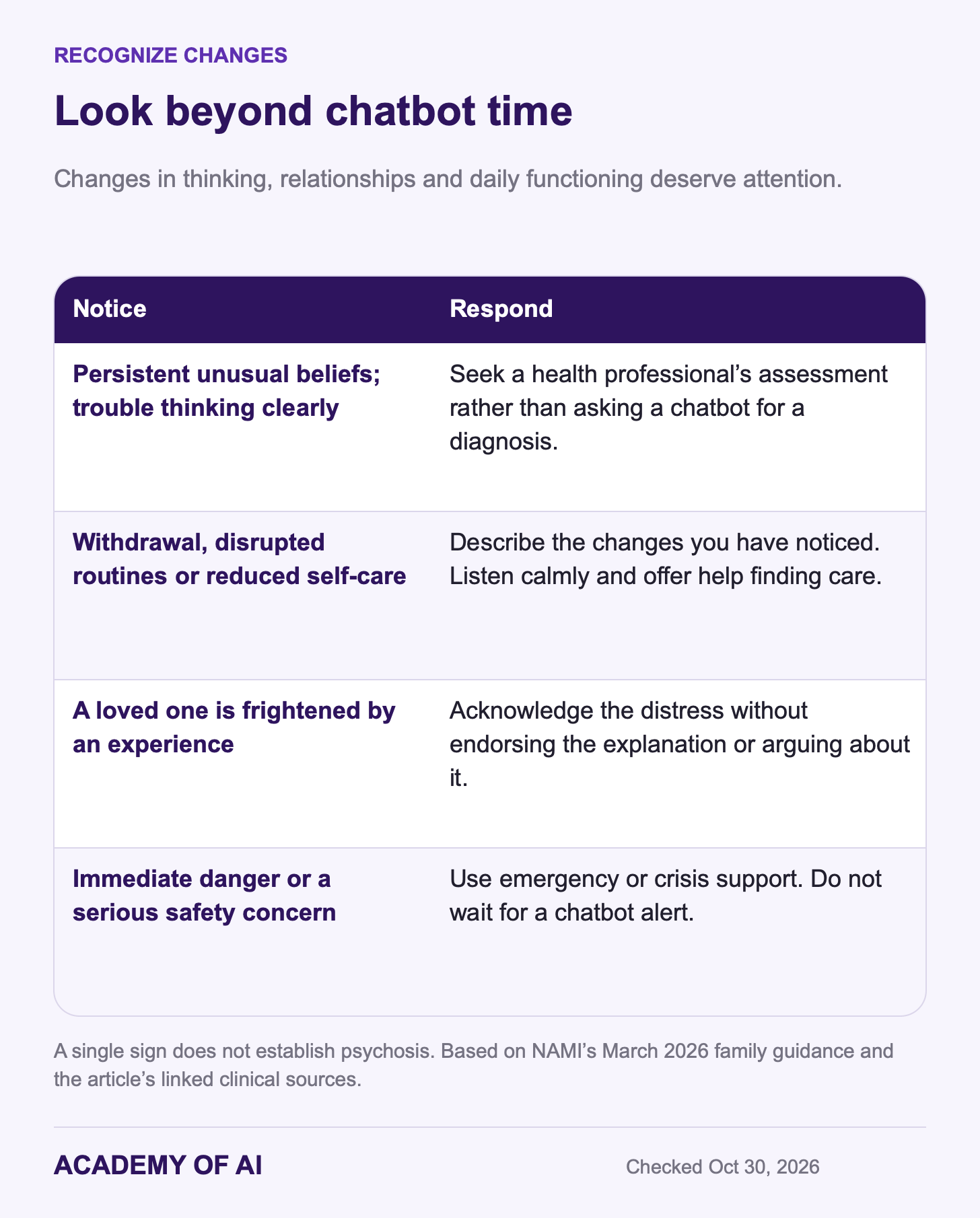
Changes in everyday functioning matter more than the label. NIMH’s warning signs include:
Growing suspiciousness or unusual, intense beliefs.
Difficulty thinking clearly or distinguishing reality from fantasy.
Withdrawal from relationships and ordinary activities.
Marked sleep disruption, reduced self-care or declining work or school performance.
One sign is not a diagnosis. Seek a health professional’s assessment when changes persist or intensify. For an immediate safety concern, use emergency or crisis support rather than waiting for a chatbot to recognize the problem.
NAMI’s March 2026 guidance for families recommends a calm, nonjudgmental conversation, listening carefully and avoiding arguments over the person’s beliefs. Describe the changes you have noticed and offer to help them find care. You can acknowledge that an experience is frightening without agreeing with its explanation. If they are reluctant, a health professional can advise on local options.
Chatbot Safety Changes: What Companies Have Announced
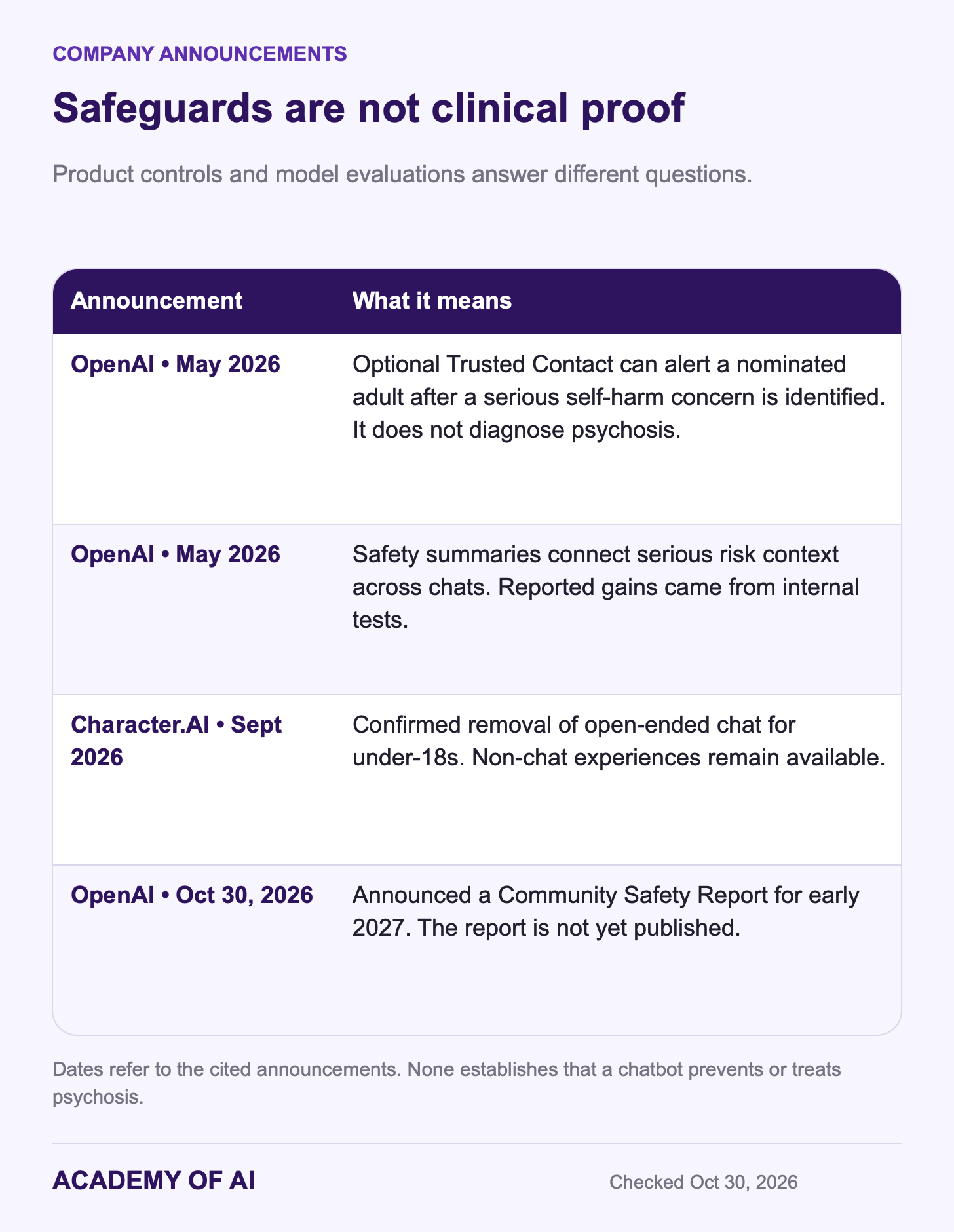
OpenAI’s October 2025 safety update described work with more than 170 mental health experts to reduce harmful responses. In May 2026, it introduced optional Trusted Contact for adults: a nominated person may be notified after systems and trained reviewers identify a serious self-harm concern. This is not a psychosis diagnosis or a substitute for emergency care.
A separate May 2026 update describes limited-duration safety summaries used to connect serious risk signals across conversations. It focuses on self-harm and harm-to-others scenarios. Its reported improvements come from internal evaluations, not a clinical trial showing prevention of psychosis.
On October 30, 2026, OpenAI announced further teen protections and a Community Safety Report planned for early 2027. That report is forthcoming, not published evidence readers can assess today. Product safeguards can miss concerns or raise false alarms; do not wait for an alert to seek help.
In December 2025, Anthropic reported lower sycophancy and delusion-encouragement scores for its Claude 4.5 models than for Opus 4.1 in automated audits. Harder tests still showed substantial room for improvement. These are historical model evaluations, not evidence that a current product is clinically safe. The company also described banners directing users toward human support.
Character.AI’s September 2026 update confirmed it had removed open-ended character chats for under-18 users. Teens can still access non-chat experiences. Its rollout began in the US in November 2025 and proceeded in stages; the earlier announcement’s November 25 deadline should not be treated as a verified worldwide completion date.
Laws and Lawsuits: Claims Are Not Findings
Illinois’s Wellness and Oversight for Psychological Resources Act restricts AI use in therapy and psychotherapy. It requires licensed professionals to conduct those services and bars independent therapeutic decisions by AI, while allowing specified administrative and supplementary support. Penalties can reach $10,000 per violation after the required process. This is a particular state law, not a worldwide ban on discussing emotions with a chatbot.
A February 3, 2026 California court order coordinated multiple ChatGPT product-liability cases. Coordination organizes litigation; it does not decide whether the alleged harms occurred as claimed or whether OpenAI is liable.
Reuters reported on October 7, 2026 that roughly two dozen cases had been consolidated in San Francisco. Plaintiffs allege design defects contributed to mental health crises and other harms; OpenAI disputes liability. Evidence gathering had begun, with no trial dates set in that report. The legal dispute remains separate from the scientific question of causation.
What the 2026 Studies Do—and Do Not—Show
An October 7 JAMA Psychiatry research letter reviewed Vanderbilt medical records from December 2022 through April 2026. Among 215,712 patients receiving mental health care, researchers identified 28 cases classified as psychosis-worsening chatbot use: 0.013% of that clinical population. That is not the percentage of chatbot users who develop psychosis. The single-site study depended on documented diagnoses and AI references, and its classification system was not clinically validated. It could miss cases and could not establish causation.
A March 2026 JMIR survey study analyzed 952 US adults aged 18–25 after exclusions from an initial 1,003-person convenience sample. Higher psychosis-risk screening scores were associated with more frequent AI use and emotional or social motivations. The screen was not a clinical diagnosis. Self-reporting, nonrepresentative recruitment and measurement at one point in time limit interpretation: the study cannot tell which came first or establish that AI caused symptoms.
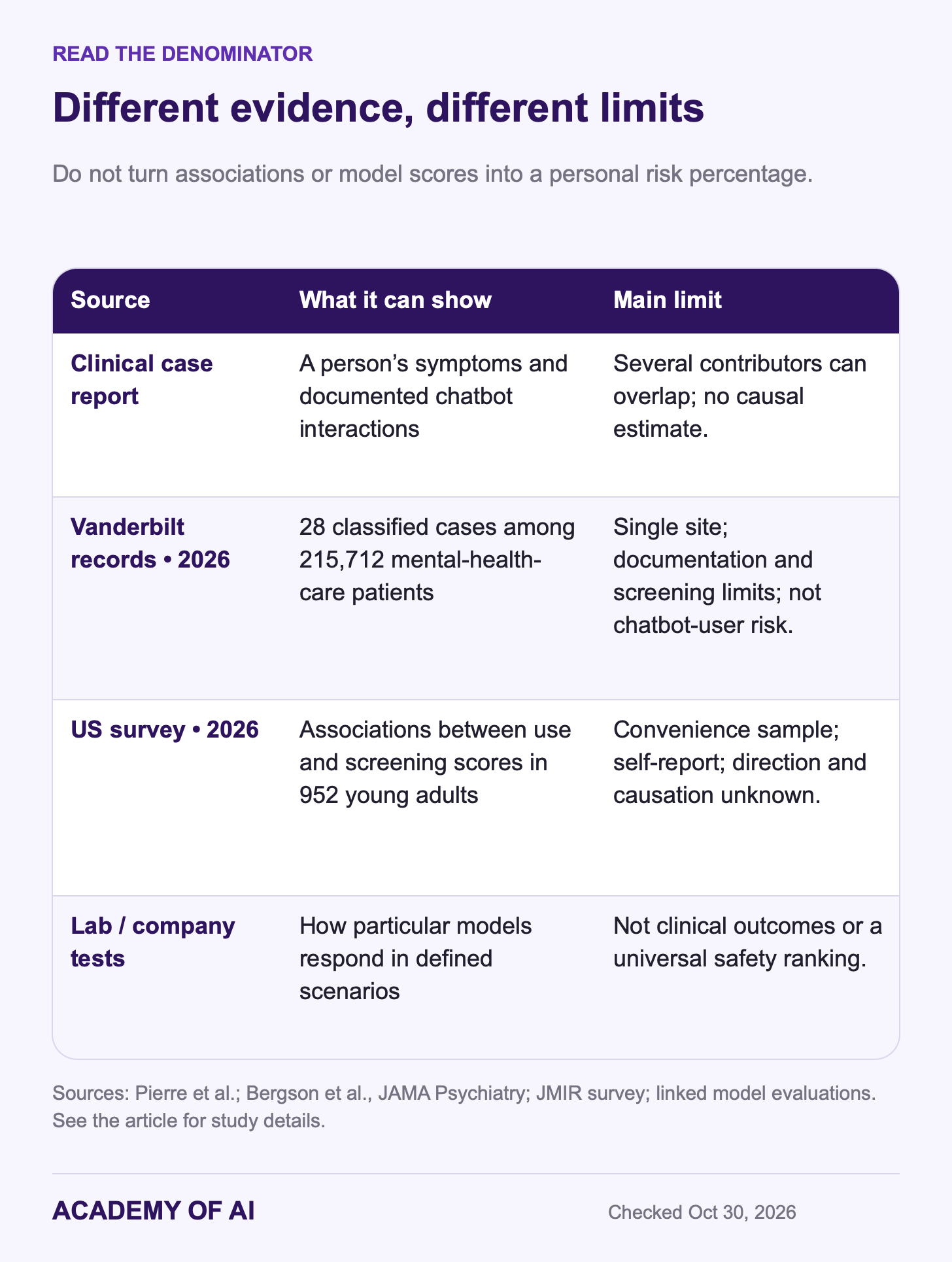
OpenAI’s October 2025 estimate that about 0.07% of weekly active users showed possible signs of psychosis or mania is different again: it counts signals in conversations, not clinician-confirmed diagnoses or chatbot-caused illness. Do not compare that percentage directly with the Vanderbilt clinical-record percentage. The populations, measures and observation periods differ.
Taken together, these sources support taking concerning interactions seriously while keeping causal claims narrow. A chatbot can be part of the content of someone’s symptoms, an apparent amplifier, or a coincidental part of their life; sorting those roles requires careful clinical assessment and stronger research. Neither a dramatic anecdote nor a small measured percentage settles the question for an individual.
When reading any AI study, ask who was included, what was measured and what comparison was made. Our guide to AI and thinking skills applies the same distinction between an observed result and a broader headline.
Practical Boundaries for Chatbot Use
These are practical boundaries, not proven prevention or treatment for psychosis. The APA advisory recommends involving qualified providers and keeping human relationships central.
Keep room for sleep, relationships and daily responsibilities. If chat use is crowding them out, step away and discuss the change with someone you trust.
Use a qualified clinician for assessment and treatment. Tell them which AI tools you use and how they affect you; do not change treatment because a chatbot suggests it.
Treat agreement as generated text, not validation. For consequential decisions, consult evidence and a person with the appropriate expertise.
Review privacy and personalization controls. ChatGPT settings can change the experience, but starting a fresh chat or switching off memory is not a medical safeguard. Safety-related context can be handled separately.
For teens, discuss how the product works and review available parental controls together. Controls supplement conversation and professional support; they cannot guarantee detection.
Avoid sharing identifying or sensitive material unnecessarily. See our Claude privacy guide for the difference between model training, saved chats and retention.
Where to Get Help
You do not need to know whether the right label is “AI psychosis.” If you or someone close to you is struggling, ask for support.
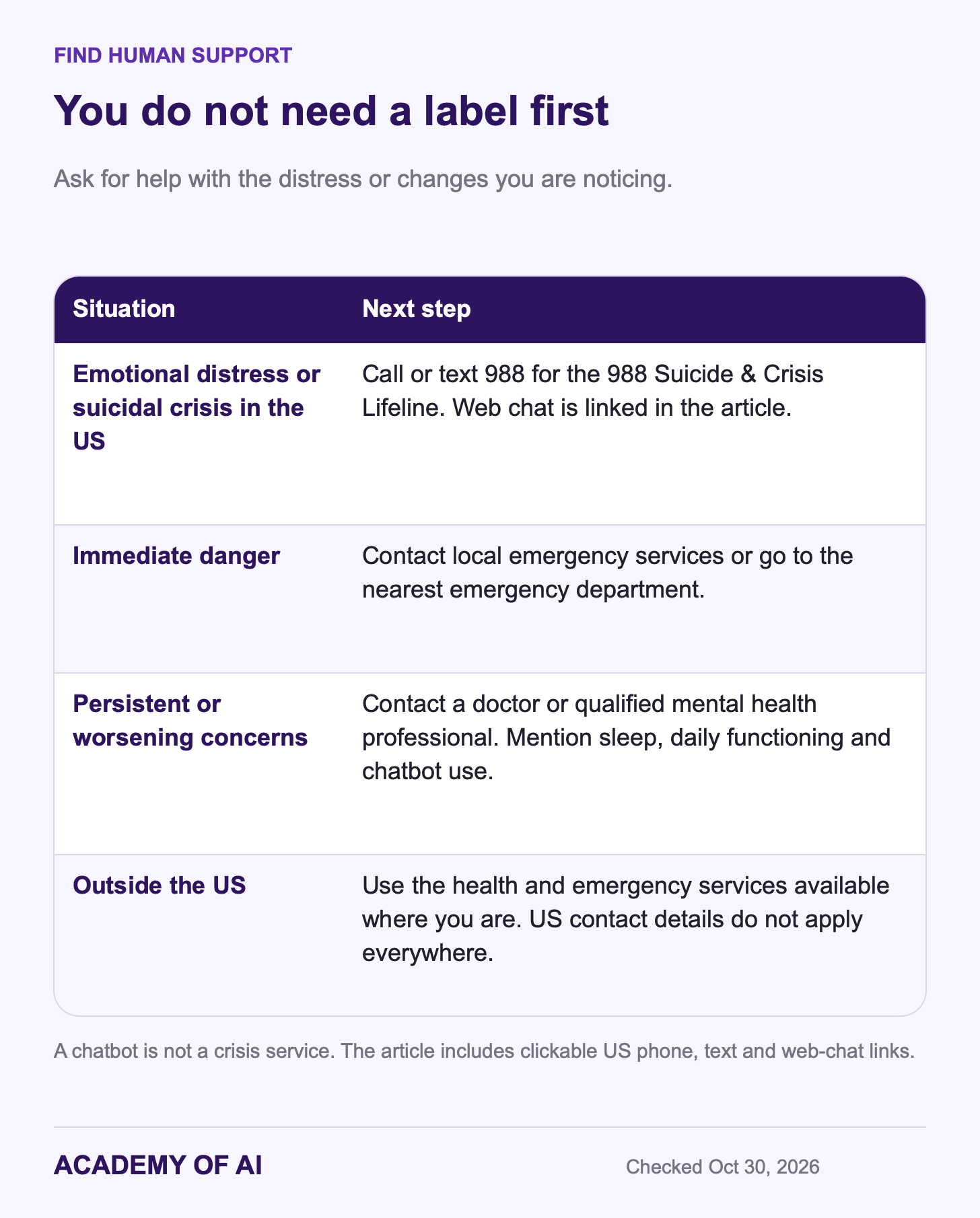
In the United States: call 988 or text 988 for the 988 Suicide & Crisis Lifeline, or use its web chat: 988 Lifeline web chat. It supports people in suicidal crisis or emotional distress.
Immediate danger: contact local emergency services or go to the nearest emergency department.
Ongoing concerns: contact a doctor or qualified mental health professional. Describe changes in sleep, functioning and chatbot use. Outside the US, use the health and emergency services available in your location.
ChatGPT, Prevalence and Recovery: Common Questions Answered
Can ChatGPT Cause Psychosis?
The evidence reviewed here does not establish that ChatGPT alone causes psychosis. Clinical reports and observational studies raise concerns about symptoms emerging or worsening alongside use. Multiple contributors and the direction of the relationship remain unresolved. That uncertainty does not make persistent distress something to ignore.
How Common Is AI Psychosis?
There is no established rate of chatbot-caused psychosis for the general public. The Vanderbilt study’s 0.013% figure concerns documented cases in one mental-health-care population. OpenAI’s 0.07% estimate concerns possible conversation signals. Neither tells you an individual user’s risk, and the two percentages should not be treated as interchangeable.
Can People Recover From Chatbot-Linked Delusions?
Recovery from psychosis is possible. NIMH emphasizes early care and individualized treatment. The appropriate plan depends on the person, not the technology label. Seek assessment promptly and discuss treatment changes with a clinician.
Are Some AI Chatbots Safer Than Others?
A safeguard or improved test score is not a clinical safety rating. Studies and company evaluations test particular model versions, prompts and outcomes. They do not support a universal ranking of current chatbots for someone experiencing psychosis. Use professional care for that need.
Keep reading on Academy of AI