



Claude Max costs $100 a month and gives you five times Pro’s usage in both the five-hour and weekly windows. It is worth considering when Pro repeatedly interrupts work that matters to you. The $200 option is now called Ultra. It gives ten times Pro’s weekly allowance and removes the five-hour limit for verified accounts.
This guide uses Anthropic’s Max documentation, its pricing page and current product help, checked October 30, 2026. It is a plan analysis, not a hands-on capacity test. I would judge the upgrade by actual interruptions and spending, because the same allowance stretches differently across models and tasks.
What Claude Max Adds Over Pro
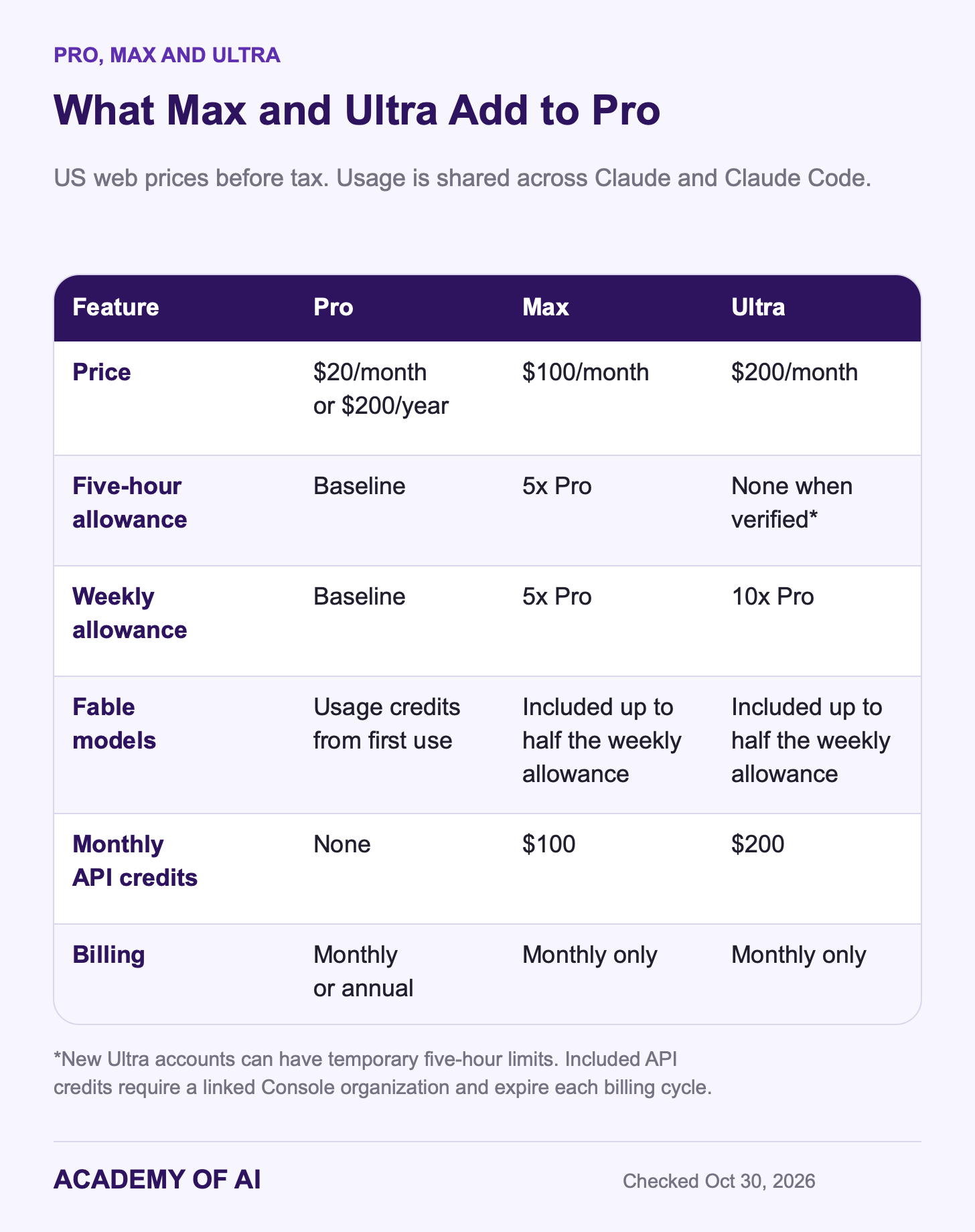
More capacity is the main reason to upgrade. Max’s five-times multiplier applies to both its session and weekly allowances. Chat, Claude Code and Cowork share those limits. Moving a task from a chat window to a coding session does not create a fresh pool. Ultra replaces the old Max 20x tier; the difference between the two current plans is explained below.
Max also includes Fable models within a separate allowance of up to half the weekly limit. On Pro, Fable bills to usage credits from the first message. Max’s included Fable use still draws from the overall allowance, and these models use it faster than lighter models.
The other meaningful extra is $100 in monthly API credits. These go to a linked Claude Console organization for eligible API and agent work. They do not refill the allowance in the Claude app or interactive Claude Code. Ultra includes $200. I would count those credits as a benefit only if I had eligible work for them.
Anthropic also advertises early access to advanced features and priority at busy times. Those benefits are harder to value than a limit that repeatedly stops a paid project. I would not upgrade on priority access alone.
Claude Max Price, Billing Rules and Regional Differences
Max is $100 a month and Ultra is $200 a month for US web subscriptions, before tax. Neither has an annual option. Pro offers $20 monthly or $200 paid up front for a year. Regional prices, taxes and mobile-app prices can differ, so compare the amount shown at checkout.
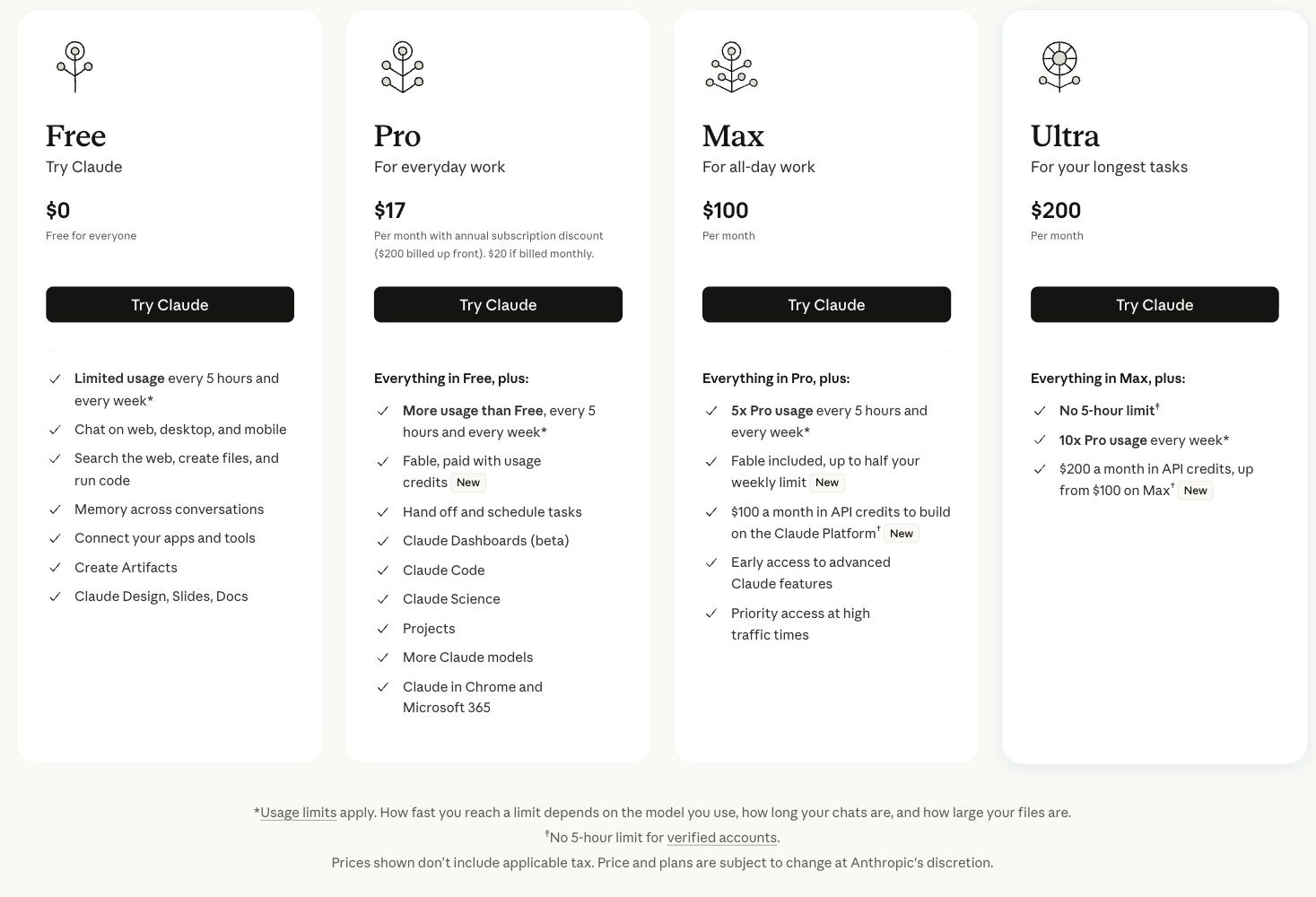
Before switching plans, check where you subscribed. Anthropic’s billing guidance distinguishes web upgrades from Google Play:
Max to Ultra on the web: the upgrade is prorated for the rest of the billing cycle.
Annual Pro to Max: remaining value can be credited toward future charges. Anthropic says the billing address must match the existing subscription.
Google Play: you pay the full new price; unused value becomes extra days before renewal.
Monthly billing makes a short trial possible, but it still renews. Check your renewal date and cancellation instructions in the service where you subscribed. Read the displayed refund terms before paying rather than assuming an unused month will be refunded.
Claude Max Plan Usage Limits: Five-Hour and Weekly Windows
Max has a five-hour session limit and a weekly limit. The weekly reset happens at a fixed time assigned to your account, shown in Settings > Usage. Reaching either limit can interrupt work. A large weekly balance does not prevent a busy afternoon from exhausting the session allowance.
The multiplier is published; an exact number of finished tasks is not. A short email, a long document review and a coding session use different amounts. Model choice, files and tools matter too. Track the reset times and what you were doing when a limit appeared. Those observations are more useful than somebody else’s prompt count.
When a limit stops you, usage credits can pay for additional work, or you can wait for the reset. A higher plan may help if interruptions are regular. Free limit resets sometimes appear in Settings > Usage, but they are not guaranteed. Before paying more, review the habits in our Claude usage guide.
Who Should Consider the Claude Max Plan?
These four work patterns are reasons to check your usage. None automatically means you need Max. The useful signal is whether more capacity would remove a recurring obstacle, or replace spending you already make.
Daily Claude Code Builders
Claude Code can make repeated requests while reading files, running tools and checking changes. Parallel sessions and agents add more activity. Anthropic’s cost guide tells organizations to budget more for coding than for chat. That explains why coding can consume an allowance quickly; it does not establish a fixed cost for your next project.
If Pro repeatedly stops client-site work or product development, compare the extra $80 for Max with your actual delay and overflow costs. Keep usage credits off if you want the subscription fee to be your spending ceiling. Once you enable paid overflow, the total can exceed $100. Our Claude Code pricing guide covers those billing controls.
Multi-Step Work in Claude and Cowork
Claude can create documents, spreadsheets and slides, and paid plans can hand off longer tasks. Feature access has expanded: the current Free plan lists Design, Slides and Docs. Buying Max is not required simply because you want a document or presentation.
Consider a marketing consultant preparing a client report, a deck from call notes and a spreadsheet cleanup. That is a plausible use for more capacity, especially if the jobs run for several steps. It is still a hypothetical example. Try the workflow on your current plan and record where it stops before choosing the upgrade.
Long Research and Large Projects
Large attachments, research tools and long conversations can use more allowance than a short draft. A consultant reviewing an RFP alongside several reports may notice the difference. Keep each project focused and avoid repeatedly attaching material the task does not need. Our Claude Projects setup guide shows how to organize the context.
Fable is a separate reason to compare costs. It is included within Max and Ultra’s limits, while Pro uses credits for it. Try the model on work where you can judge the result. If a lower-cost model does the job, included access to a more expensive one is not a reason to increase your bill.
API Tinkerers Who Will Spend the Credits
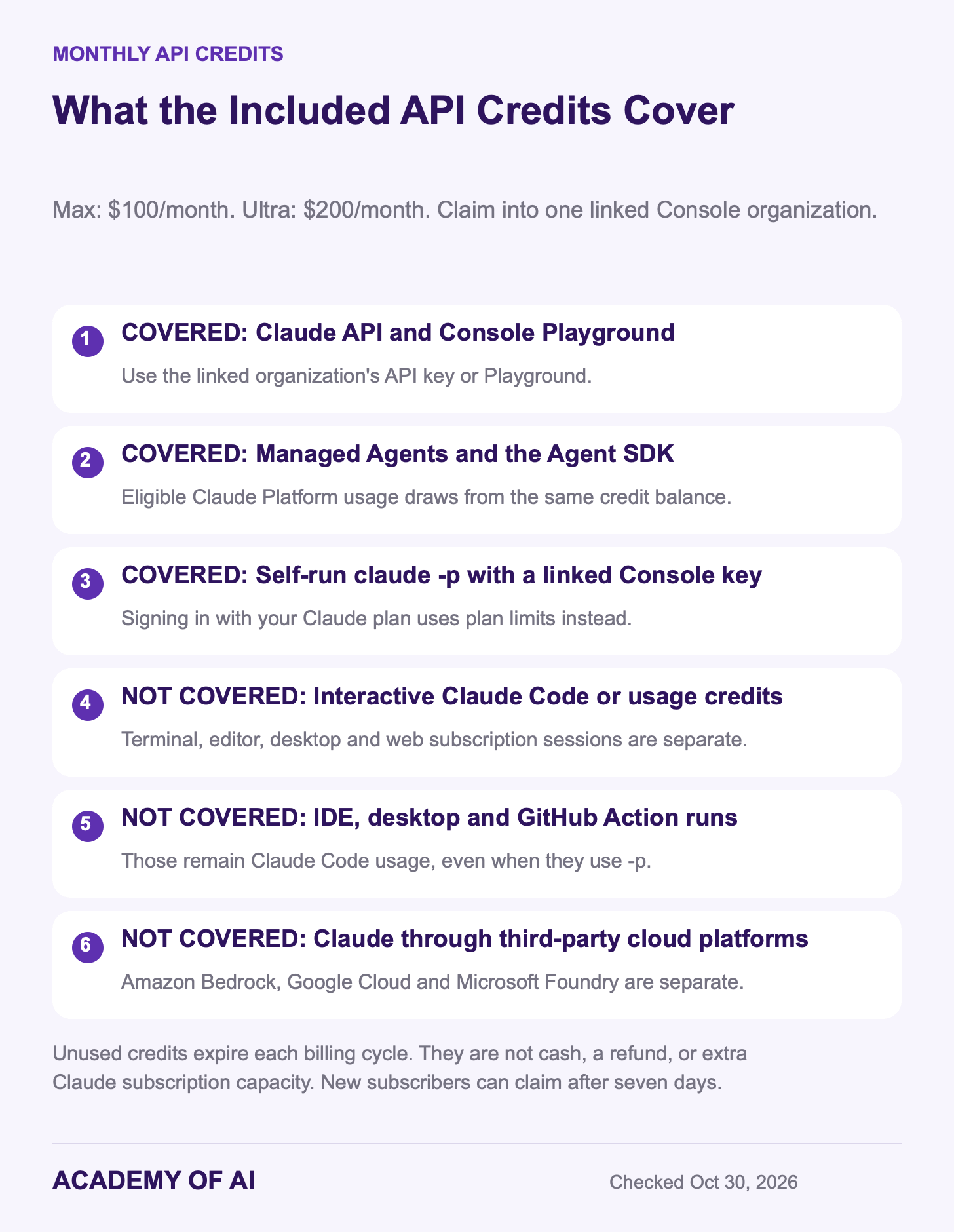
Max includes $100 and Ultra $200 in monthly API credits. Eligible uses include the Claude API, Console Playground, Managed Agents and Agent SDK. Self-run claude -p jobs qualify when they use an API key from the linked Console organization. Interactive Claude Code, subscription usage credits and third-party cloud services do not qualify. Runs started by the desktop app, an IDE extension or the Claude Code GitHub Action remain excluded, even with -p.
New eligible subscribers can claim after seven days through Settings > Billing. You link one Console organization; unused credits expire each billing cycle. They are not cash back. For example, if you would otherwise spend $30 on eligible API work, a $100 credit may avoid that $30 expense. It does not make the subscription free or give you $70 to spend elsewhere.
Cheaper Options: Pro With Credits, or Team for Two People
If interruptions are occasional, waiting may be enough. Pro plus a $20 monthly usage-credit cap, for example, totals at most $40 in subscription and usage-credit spending before tax, assuming no separate API charges. That is below Max’s $100 fee. Credits are not automatically cheaper: the cap and your actual consumption determine the comparison.
Brief chats and occasional coding may fit Pro comfortably; long research or file-heavy conversations may not. Start new conversations for unrelated work, and try a lighter coding model when its output meets the task. Judge the plan by results and interruptions, not whether you describe yourself as a power user.
For two or more people, compare separate Team seats. Premium is $125 per person monthly or $100 per month on annual billing, with 6.25 times Pro’s session allowance. Team has central administration and commercial data terms. Each seat is for one named person; allowances cannot be shared. Annual Premium matches Max’s monthly price per person but requires the annual commitment.

Claude Max vs Ultra: Which Plan Fits?
Max is $100 a month for five times Pro’s session and weekly allowances. Ultra is $200 for ten times Pro’s weekly allowance, with no five-hour limit on verified accounts. If Max gives you enough room, the larger plan adds cost without a useful benefit. If long sessions keep stopping or weekly capacity is too small, Ultra is worth comparing.
The old Max 20x label described a session multiplier. Ultra’s 10x figure describes weekly usage. Anthropic says existing Max 20x subscribers move to Ultra without a price increase or a change to their weekly limit. The new name does not mean the weekly allowance was cut in half. Verification is automatic; new accounts may temporarily retain a five-hour limit.
Both Max and Ultra include Fable up to half their weekly allowance. Ultra also doubles monthly API credits to $200. Those extras matter only if you can use them. Before upgrading for a long task, confirm the limits shown on your own account.
Claude Max’s Drawbacks: Limits, Cost and Account Controls
The biggest drawback is that a usage multiplier does not tell you how many projects you will finish. You still have weekly limits, and Max also has the five-hour window. Paying more can reduce interruptions; it cannot promise a finished app, an accurate report or a fixed number of productive hours.
Max is monthly only, its included API credits do not extend interactive Claude Code sessions, and Fable can consume the weekly allowance quickly. It also lacks Team’s central administration and billing. Those are material differences if you are buying accounts for a business.
An upgrade keeps you in the same Claude interface. It does not improve your instructions or review process by itself. If the problem is generic output rather than limits, start with our guide to using Claude effectively before paying for more capacity.
Privacy on Max: Consumer Terms and the Training Setting
Max and Ultra are consumer plans. For Claude Code specifically, Anthropic’s data-usage documentation ties model training to your model-improvement setting and lists five-year retention when enabled, versus 30 days when disabled, with exceptions. Those Code rules are not a promise that every saved Claude chat disappears after 30 days. Team, Enterprise and API use commercial terms with no model training by default.
For client or company data, confirm that the account and terms are approved for the work. A training toggle alone does not settle confidentiality, retention or access. Review the setting at Data privacy controls and read our Claude privacy explainer for the broader rules.
Is Claude Max Worth It for Solo Builders?
I would start with Pro unless there is already a clear reason to need more. Watch usage for a couple of normal working weeks. If limits repeatedly interrupt valuable work, compare a month of Max with the cost of waiting or buying capped credits. Ultra is the next comparison when Max’s capacity or session window is the constraint.
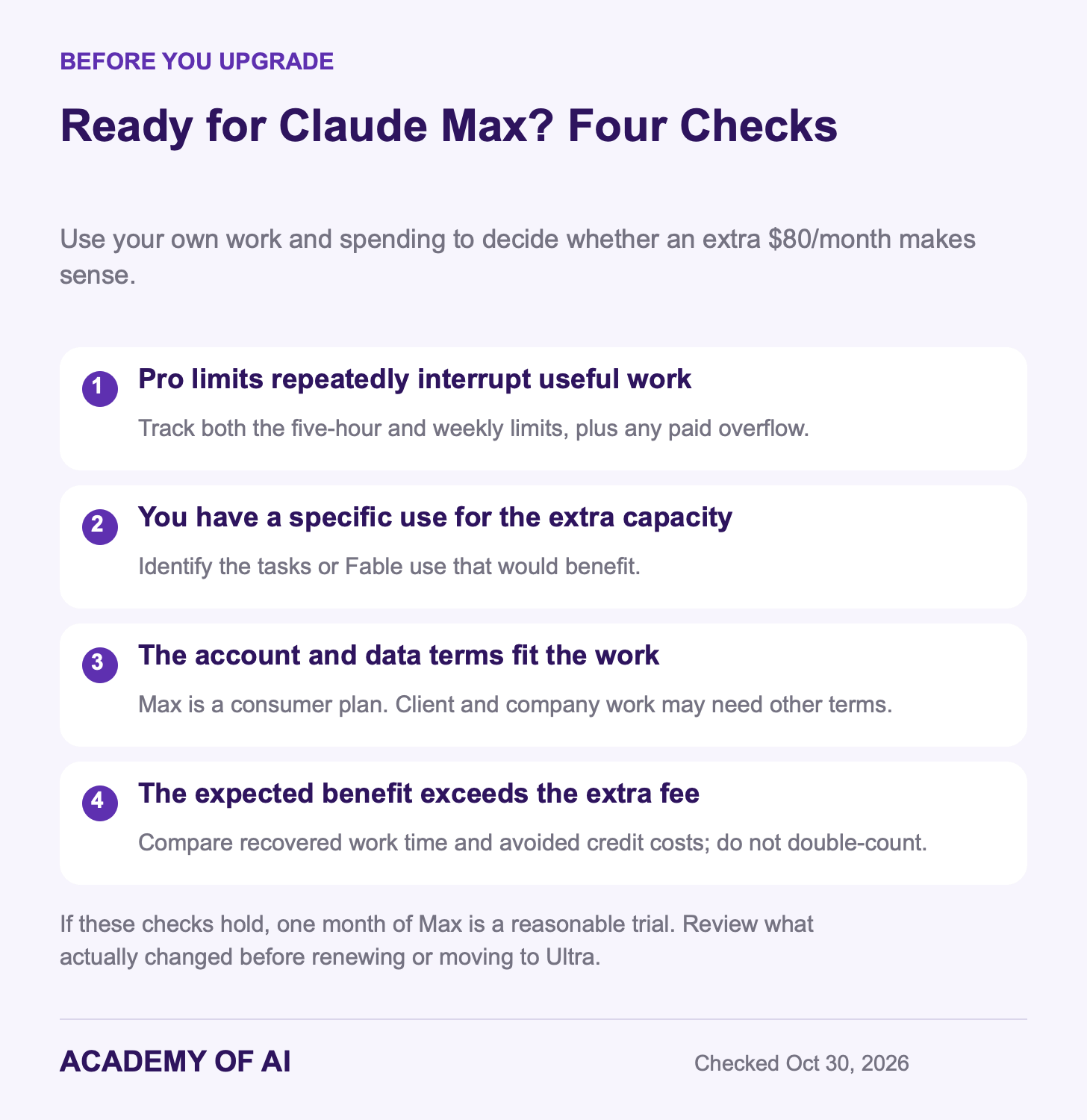
Best fit: someone whose real work repeatedly exceeds Pro’s capacity, or whose eligible Fable and API use makes the added fee worthwhile.
Wait or choose another plan: if Pro handles your work, if occasional capped credits cost less, or if your organization needs commercial terms and administration. For a team, price separate seats for each person.
My deciding check: would the extra capacity save more than the added cost after accounting for review and corrections? A hypothetical two useful hours recovered at $50 an hour could justify an $80 upgrade. Two hours of extra prompting with no usable result would not. Count credit savings and time carefully so you do not count the same benefit twice.
Max Plan Questions: Unlimited Use, Annual Billing, Cancellation
Is Claude Max Unlimited?
No. Max has both five-hour and weekly limits. Ultra removes the five-hour limit for verified accounts, but weekly limits still apply. Optional usage credits let you keep working beyond included limits until your cap or available balance is reached.
Can You Pay for Claude Max Annually?
No. Max is billed monthly only. If annual savings matter, Pro is $200 a year up front. Team seats are also cheaper on annual billing ($100 instead of $125 for Premium), as long as you have at least two members.
Does Claude Max Include Claude Code?
Yes. Max includes Claude Code in the terminal, supported editors, the desktop app and cloud sessions in the browser. Usage is shared with Claude chat and Cowork. You do not need Ultra just to get Claude Code.
What Happens When You Cancel Claude Max?
Your plan stays active until the end of the paid month, then the account moves to Free. New monthly API credits stop, but credits already issued stay usable until they expire at the end of their cycle.
Keep reading on Academy of AI