



Claude Code pricing starts at $20 a month with Claude Pro, or $200 paid up front for a year. Max costs $100 a month; Ultra costs $200. All three include Claude Code. You can also use the terminal tool with pay-per-token API billing instead of a subscription.
These are US prices before tax, checked October 30, 2026 against Anthropic’s pricing page. The decision is about how you work: occasional projects, regular building or long sessions that keep hitting limits. Below, I separate the subscription fee from the two kinds of credits that can add to your bill.
Is Claude Code Free? What the Free Plan Leaves Out
The software is free to download, but the Free plan does not include Claude Code. A paid Claude subscription is the straightforward route into its desktop and browser interfaces. The terminal tool can instead use a funded Claude Console account or a supported cloud provider. A free download does not mean free model usage.
For an individual, the subscription choices are Pro, Max and Ultra. Team and Enterprise serve organizations. API billing through Claude Console is separate; so is billing through providers such as Amazon Bedrock. Anthropic’s setup guide explains the access options.
You can read the documentation and take Claude Academy courses without buying a plan. Running the exercises in Claude Code requires an eligible account.
Claude Code Pricing: Pro, Max and Ultra Compared
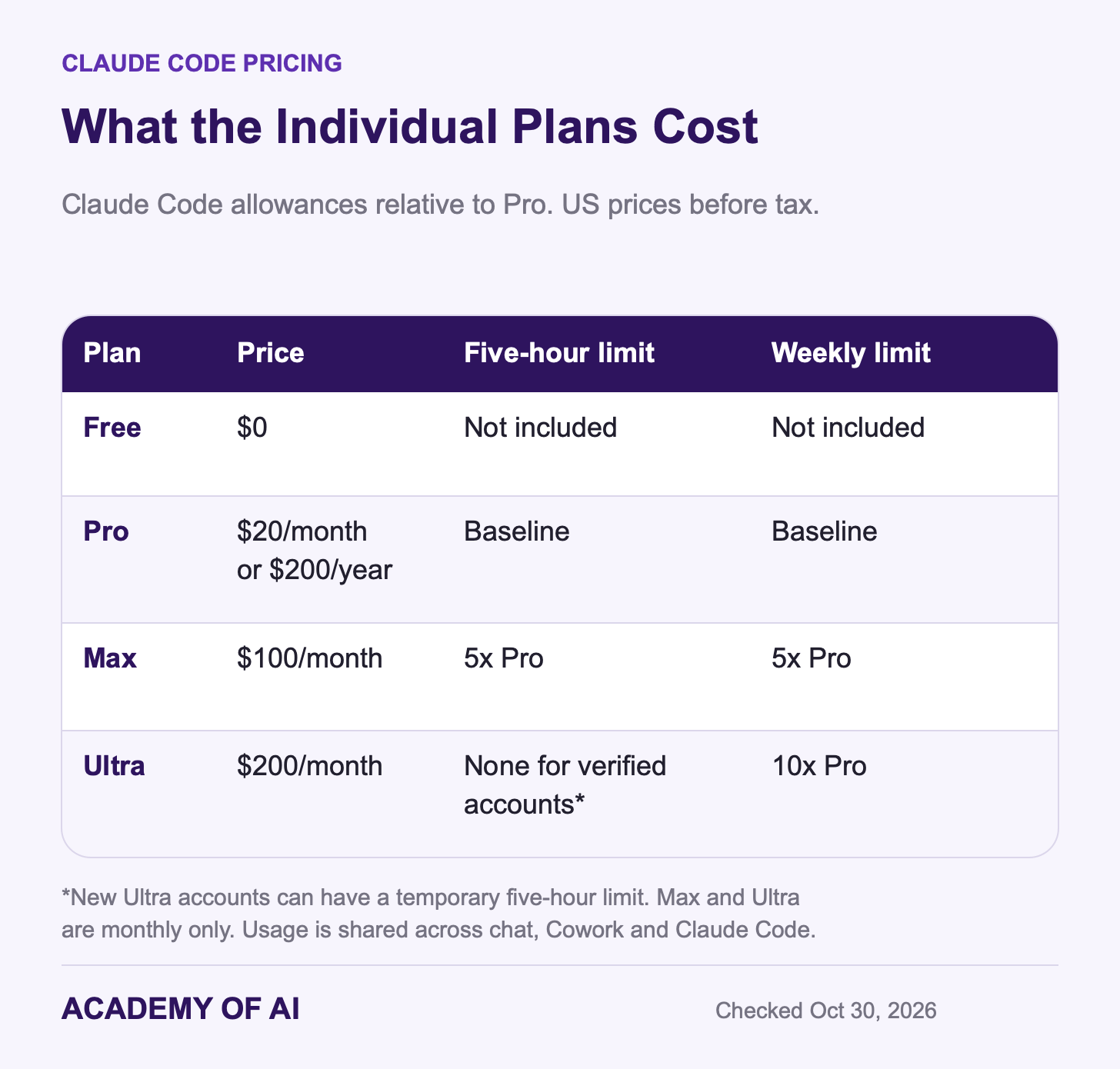
Pro costs $20 a month or $200 a year. Anthropic rounds the annual equivalent to $17 a month; you pay the full $200 up front. Max costs $100 a month and Ultra costs $200 a month. Both are monthly only. Ultra replaces the former Max 20x tier, and existing Max 20x subscribers move over at the same price.
Those are US prices for sign-ups on the web. Anthropic’s Pro article says monthly pricing varies by region and is charged in local currency where supported. Some regions show tax in the price, and others add it at checkout. The Max article warns that pricing in the mobile apps can differ by platform, so compare the web price before you subscribe from your phone.
Pro already includes Claude Code in the terminal, supported code editors, the desktop app and cloud sessions. Max and Ultra add capacity, included Fable usage and separate API credits. Our Claude Max guide explains whether those extras match your work.
How Claude Code Usage Limits Work
On Pro and Max, you have a five-hour session limit and a weekly limit. Max provides five times Pro’s allowance in both windows. Ultra has ten times Pro’s weekly allowance and removes the five-hour limit for verified accounts. New Ultra accounts can have a temporary session limit until Anthropic verifies them. Chat, Cowork and Claude Code share the relevant limits; buying a separate-looking interface does not create another allowance.
Those multiples do not translate into a fixed number of prompts. Conversation length, model choice, files and tool use affect consumption. Check Settings > Usage for your account’s limits and reset times. A post promising an exact number of coding tasks per month cannot know what your tasks will involve.
Model choice matters. Current Claude Code versions default to Opus 5.5 on individual plans, unless your settings choose something else. For routine changes, try /model sonnet and check the results. Anthropic’s cost guide also recommends managing context. Long histories and repeated tool calls add work, though caching and compaction affect the cost. Use /clear when moving to an unrelated task; it clears the conversation, so save any instructions you still need first.
Use /usage in Claude Code to check consumption. If a response reaches a five-hour limit midway through a step, Claude Code may briefly finish that step. That small wrap-up allowance is capped and still rolling out. Treat it as a convenience, not extra capacity to plan around. For everyday habits, see our guide to stretching Claude usage limits.
How Much Is Claude Code for a Nontechnical Builder?
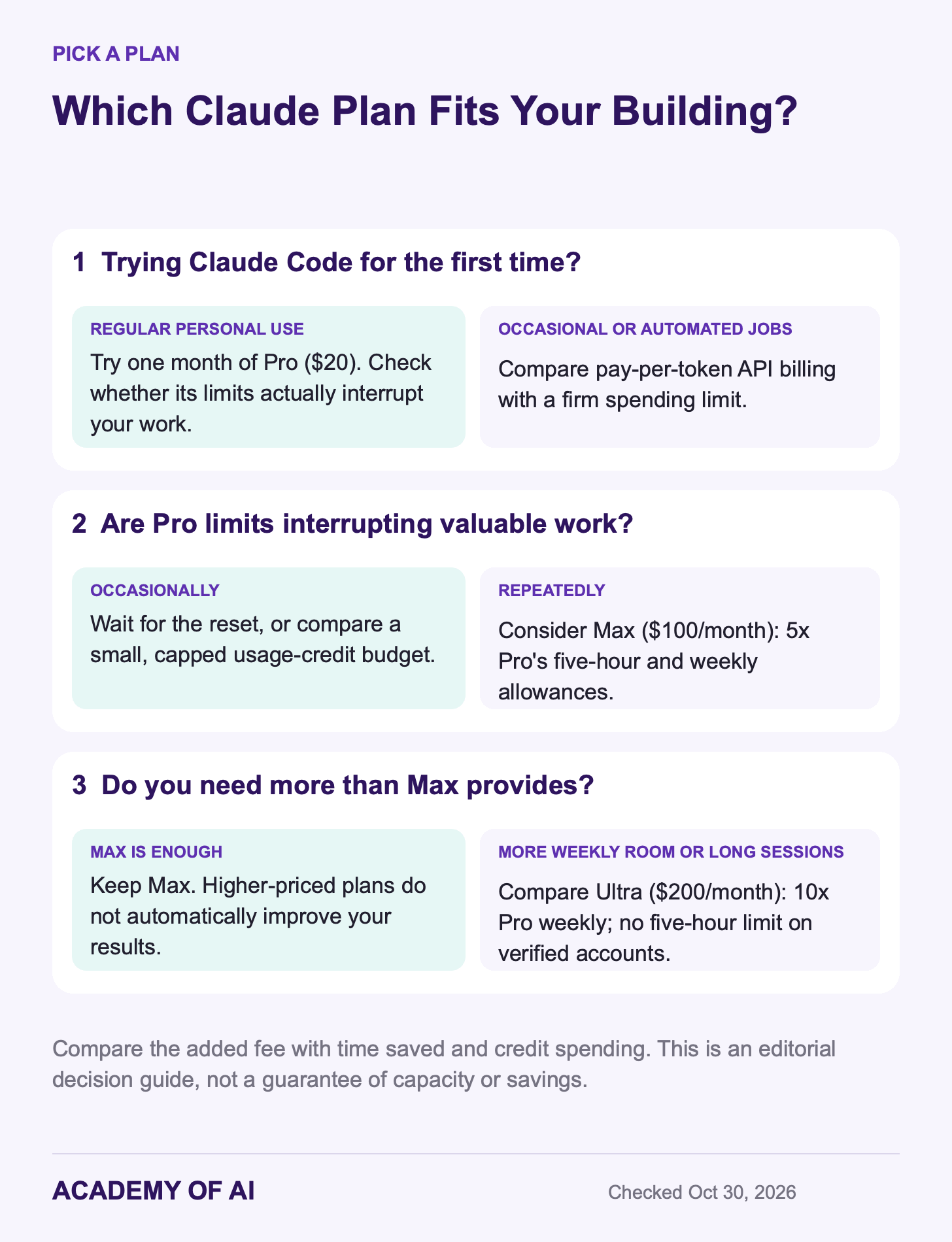
For a first personal project, I would try one month of Pro before committing to a larger bill. Pick something small: a landing page, a file-renaming script or a quote calculator. The desktop app lets you work without setting up a terminal. Our Claude Code web walkthrough covers the browser route, and our vibe coding guide explains what to check when you build through prompts.
One interrupted Saturday does not tell you that Max is worth another $80 every month. You might wait for a reset or set a small usage-credit budget. Repeated interruptions are different, whether they come from the session or weekly limit. Record what stopped, how much time you lost and what credits cost. Compare that with the upgrade fee.
Monthly Pro costs $240 over a full year, so annual billing saves $40 if you use all 12 months. I would choose the annual commitment after the tool has earned a place in my work. Check the terms shown at checkout before paying.
For client work, confirm that your organization permits the tool and account first. Pro, Max and Ultra are consumer plans. Anthropic’s Claude Code data policy says model-improvement settings affect training and retention: five years when enabled, 30 days when disabled, with separate rules for feedback and other exceptions. Turning training off does not make every upload appropriate. Our Claude privacy guide covers the broader questions.
Claude Usage Credits: Paying Past the Limit Without Upgrading
Usage credits let Pro, Max and Ultra users pay for work beyond included limits at API rates. They are optional and separate from the monthly API credits bundled with Max and Ultra. To avoid confusing the two, think of usage credits as extra spending inside your Claude subscription.
Anthropic’s current setup instructions use these controls on the web:
Open Settings > Usage and find Usage credits.
Select Enable, then add a payment method if required.
Choose Adjust limit and set a monthly spending cap.
Select Add funds, enter the amount and review the purchase.
Leave auto-reload off unless you intentionally want automatic top-ups.
With auto-reload off, work on credits stops when the balance runs out or the monthly cap is reached. Set a cap even if you start with a small balance. Credits generally do not expire, but regional exceptions apply; in Japan, purchased usage credits expire after six months.
You can also wait for the normal reset. If Anthropic gives your account a free limit reset, it appears in Settings > Usage with its expiry date. Availability varies, so do not budget around receiving one.
Check the model before you spend. Fable 5 and Fable 5.1 use credits from the first message on Pro. Max and Ultra include Fable within a separate allowance of up to half the weekly limit. Fable also consumes that allowance faster than other models. A more expensive model is worth choosing only when its result justifies the cost for your task.
Claude Code Cost on Pay-As-You-Go API Billing
With API billing, you pay for the tokens Claude processes rather than an individual subscription. A token is a small unit of text, often part of a word. Anthropic’s current base API rates per million tokens are:
Sonnet 5.5: $2 input, $10 output
Opus 5.5: $4 input, $20 output
Haiku 5.5: $0.10 input, $0.50 output for prompts up to 100,000 tokens
Fable 5.1: $10 input, $50 output
For example, one million uncached input tokens and 100,000 output tokens on Sonnet 5.5 cost $3 at those base rates: $2 for input and $1 for output. That is a worked billing example, not an estimate for a project. A coding task can make many model calls. Cache pricing, tools and other charges can change the total. Haiku 5.5 also has higher rates above 100,000 input tokens: $0.50 input and $2.50 output per million.
API billing can suit occasional use or automated jobs, but compare your actual bill with a subscription. Anthropic reports $150–$250 per developer per month for enterprise deployments in its cost guide; that is not a forecast for a beginner. Set a budget before a long run, and check Console billing controls rather than assuming a prompt can enforce your spending limit.
Team and Enterprise Seats With Claude Code Included
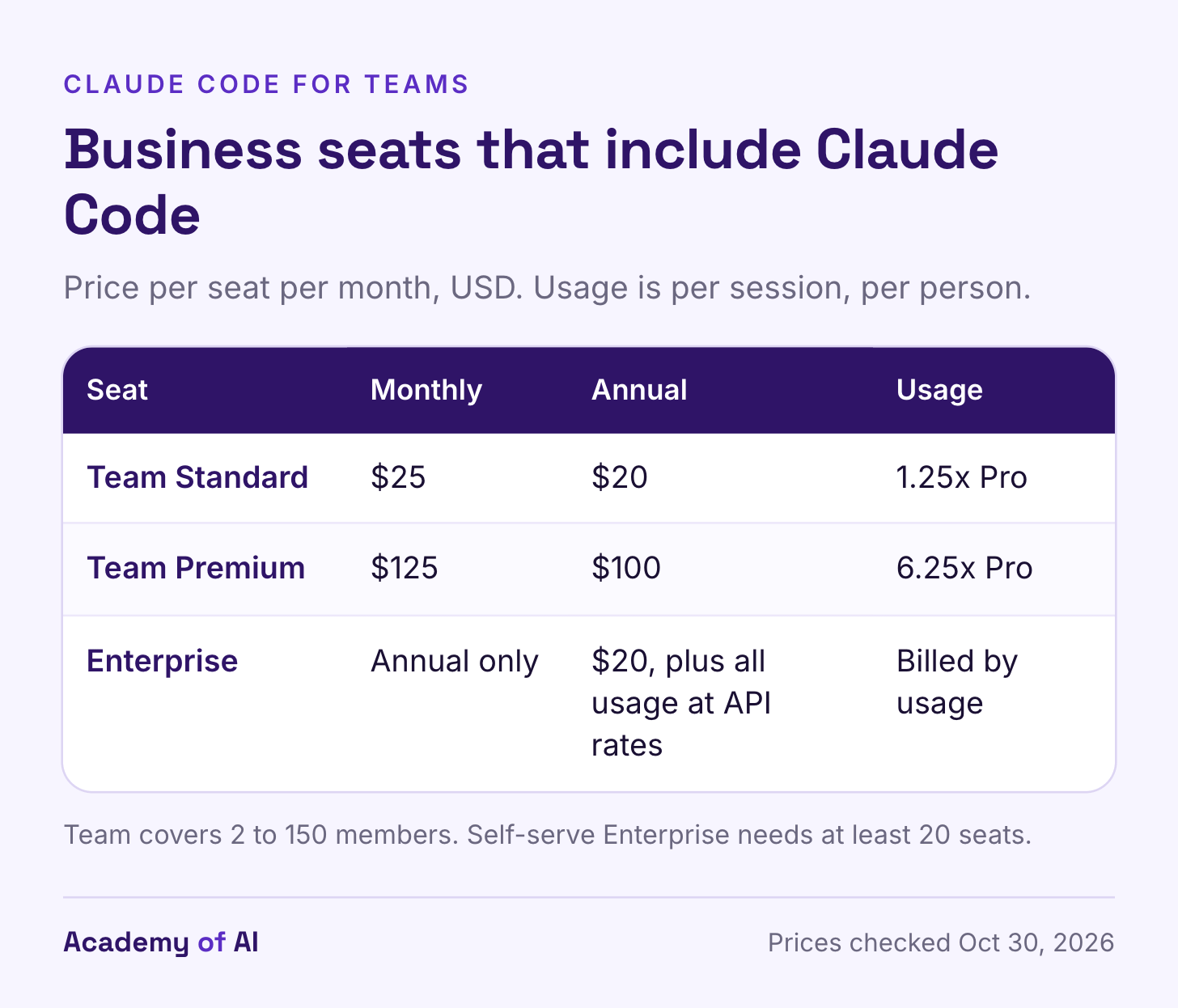
For businesses, Claude Code pricing runs through seats. Claude Team covers 2 to 150 members, and every Team seat includes Claude Code. A Standard seat costs $25 a month, or $20 billed annually, and carries 1.25 times Pro’s per-session allowance. Premium costs $125, or $100 annually, for 6.25 times Pro. Limits are per person, so one teammate’s marathon session doesn’t drain anyone else.
Enterprise charges $20 per seat per month on annual billing, then bills all usage across Claude, Claude Code and Cowork at API rates. Self-serve Enterprise needs at least 20 seats, and sales-assisted deals start at 50.
Team and Enterprise use commercial terms. Anthropic does not train on Claude Code inputs or outputs by default under those terms, and its standard Code retention is 30 days, subject to exceptions and applicable arrangements. Compare the contract and administrative controls with your client obligations. A company plan is a choice about data handling and management as well as usage.
Billing Traps: Stray API Keys and Uncapped Credits
Four setup mistakes can turn a $20 plan into a bigger bill:
A leftover API key. An
ANTHROPIC_API_KEYenvironment variable can make Claude Code bill the API instead of your subscription. Check the active account with/status. If the key is unintended for this session, remove it from that session’s configuration and use/logininside Claude Code to select your subscription. Do not delete a key used by another project.Accepting extra billing at a limit. Read the offer before continuing. Waiting for a reset is an option; paid overflow is optional.
Counting included API credits as subscription top-ups. Max includes $100 and Ultra $200 in monthly API credits. These require a linked Console organization and do not pay for interactive Claude Code or subscription usage credits. Eligible scripted API calls, including
claude -pwith a Console key, are a separate case. Unused monthly credits expire.Forgetting automatic reloads. Check both Claude usage-credit settings and Console billing. They are separate balances with separate controls.
My starting point is one month of Pro and one real project. Confirm the billing account, keep paid overflow off initially, and review the result before upgrading. If a limit blocks useful work, compare waiting, capped credits and a higher plan. The cheapest workable option depends on what you actually use.
Claude Code Price and Plan Questions
Do You Need Claude Pro for Claude Code?
You need a paid plan or API credits, and Pro is the cheapest paid plan that includes Claude Code. Team Standard seats include it as well, but Team requires at least two members. Without a plan, a Console account billed per token is the main alternative.
What Does Claude Code Cost per Month for One Person?
Pro is $20 a month, Max is $100 and Ultra is $200, before tax. Pro also offers a $200 annual option. Optional usage credits add to those prices. API billing has no fixed monthly total; it depends on consumption.
Is There a Student or Nonprofit Discount on Claude Code?
There is no standard student discount listed for the individual plans. Anthropic offers Claude for Nonprofits for eligible organizations, and its pricing page lists education options. Check those programs directly rather than expecting an individual coupon.
Can You Use Claude Code on Your Phone?
Yes, for cloud sessions. The Claude app for iOS and Android has a Code tab that starts and steers sessions running on Anthropic’s servers. That work counts toward the same plan limits as everything else.
Keep reading on Academy of AI